Valencia, May 5, 2026: The global denim industry is making measurable progress toward sustainability, according to the second annual Denim Industry Progress & Insights 2025 report released by EIM (Environmental Impact Measurement), the world’s leading platform for assessing the environmental impact of garment finishing processes.
The report analyses more than 100,000 real denim finishing processes worldwide, offering one of the most comprehensive insights into how the sector is evolving toward more responsible and eco-efficient production models.As one of the world’s most resource-intensive industries, textiles continue to face growing pressure to reduce environmental impact. EIM’s latest findings show encouraging progress, particularly in water and energy optimization, while also highlighting chemical management as the industry’s biggest remaining challenge.
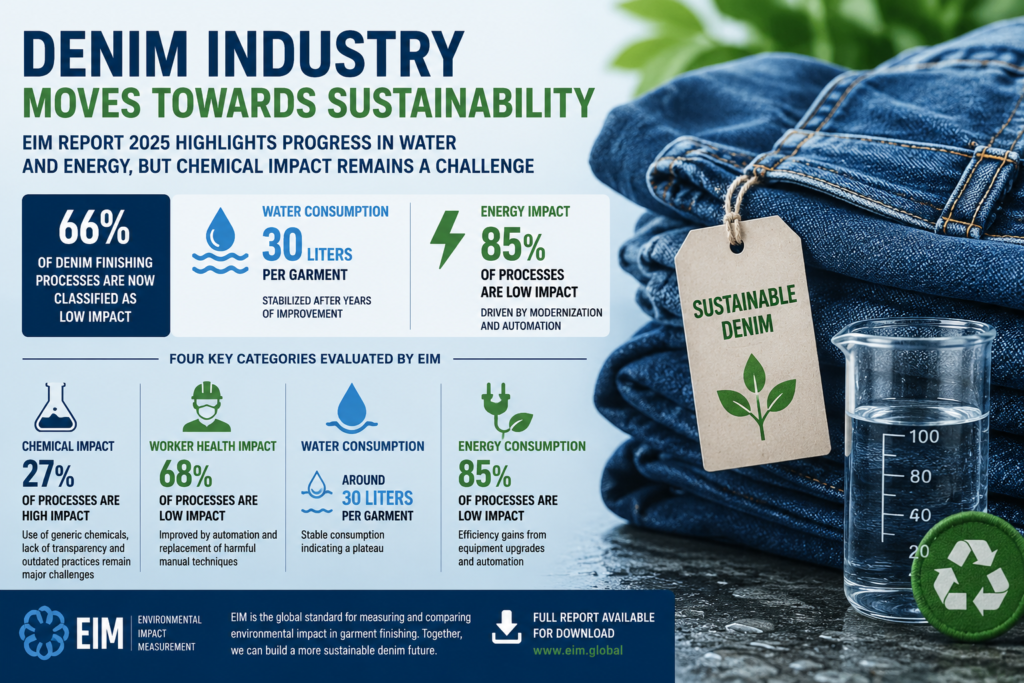
According to the report, 66% of denim finishing processes are now classified as low impact, reflecting a positive shift driven by improved process optimization and the adoption of advanced technologies.Water consumption has stabilized at approximately 30 liters per garment, suggesting that the industry may be reaching a plateau after years of steady improvement. Meanwhile, energy performance has emerged as the strongest area of progress, with 85% of processes categorized as low impact, thanks largely to equipment modernization, automation, and more efficient production systems.
Despite these gains, the report emphasizes that chemical impact remains the sector’s primary sustainability concern. Around 27% of processes are still considered high impact, mainly due to the continued use of generic chemicals, limited transparency in chemical formulations, and outdated practices such as pumice stones and potassium permanganate treatments.Worker health and safety conditions, however, have shown considerable improvement. Nearly 68% of processes are now rated low impact for worker health, driven by increased automation and the replacement of harmful manual techniques with safer alternatives.
“The industry has proven that it can improve when it measures its impact, but the next step requires accelerating the adoption of technologies and leaving behind practices that are no longer sustainable,” said Begoña García, creator of EIM and co-author of the report. “Today more than ever, we need reliable data to make informed decisions and move towards a real transformation of the industry.”
The report further strengthens EIM’s position as a global benchmark for measuring and comparing environmental performance in denim finishing. By publishing annual insights, EIM aims to help brands and manufacturers benchmark progress, identify improvement opportunities, and collectively work toward more ambitious sustainability goals.EIM evaluates denim finishing processes across four critical categories: water consumption, energy consumption, chemical impact, and worker health impact. Each process is classified as low, medium, or high impact based on standardized benchmarks designed specifically for denim finishing, garment washing, and garment dyeing.
The full report is now available for download and will continue to be updated annually, reinforcing the industry’s commitment to transparency, continuous improvement, and environmental responsibility.