
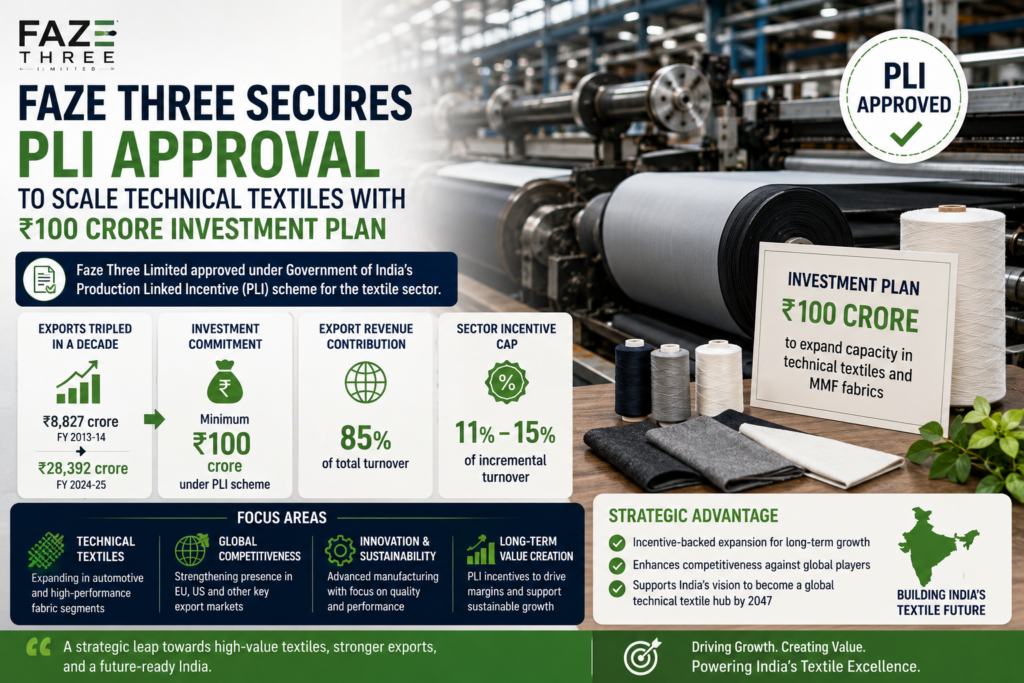
Home textile and export-focused manufacturer Faze Three Limited has secured approval under the Government of India’s Production Linked Incentive (PLI) scheme for textiles, marking a major strategic step in its expansion into technical textiles and man-made fibre (MMF) fabrics.
The company has committed a minimum investment of ₹100 crore over the coming years to scale operations in high-value textile segments, including automotive and industrial fabric applications.The approval places Faze Three among a select group of textile manufacturers eligible to receive performance-linked incentives on incremental turnover, supporting India’s broader effort to build a globally competitive MMF and technical textile ecosystem.
PLI approval to support technical textile expansion
Under the scheme, Faze Three will invest in new production capabilities at its facilities in Vapi and Panipat, with a focus on technical textiles and automotive interior fabrics. The company’s investment commitment of ₹100 crore is expected to help unlock incentives over a five-year period, depending on its ability to meet prescribed sales and production targets.
The PLI scheme is designed to promote domestic manufacturing in segments where India has traditionally lagged global competitors, especially in man-made fibres, which account for a much larger share of global textile demand than cotton-based products.
Strategic shift beyond home textiles
Faze Three has historically been known for its home textile business, but the PLI approval supports its ongoing shift toward higher-value and more specialised product categories. The company is now targeting technical textile applications with stronger pricing power and export potential, reducing dependence on more commoditised home furnishing segments.
Industry observers say the move could strengthen Faze Three’s positioning in the China Plus One sourcing trend, as global buyers increasingly look to diversify procurement away from China toward India and other Asian manufacturing hubs.
Export-led growth remains central
Exports continue to be a major pillar of Faze Three’s business, with around 85 percent of total turnover linked to overseas markets. The company is expected to leverage its established export network to drive incremental sales under the PLI scheme, particularly in the EU and US markets, where demand for automotive and technical textile solutions is growing.
The company is also expected to benefit from rising global interest in high-performance industrial fabrics, including applications in transport, mobility, interiors and specialty manufacturing.
Margins and scale may improve over time
The PLI incentives are expected to support Faze Three’s margins once new production lines are commissioned and eligible turnover begins to qualify for subsidies. Market estimates suggest that incentive-linked benefits could improve EBITDA margins over time, provided execution remains on schedule and export demand stays healthy.
In Q4 FY26, Faze Three reported a 14 percent year-on-year rise in revenue, driven by strong demand from North American customers. The company also completed a facility upgrade in Vapi, Gujarat, which is expected to become a key site for PLI-related manufacturing expansion.
Broader significance for India’s textile sector
Faze Three’s approval under the textile PLI scheme comes at a time when India is trying to rebalance its textile export basket toward MMF and technical textiles, areas where global demand is much stronger than in traditional cotton products. While India’s textile exports remain heavily cotton-driven, the government has been encouraging companies to move into performance-led, innovation-based and industrial textile segments with higher value addition.
By entering the PLI-backed technical textile segment, Faze Three is aligning itself with a long-term structural shift in the Indian textile industry—one focused on scale, export competitiveness, and advanced material manufacturing.
The key factor to watch now will be execution. The pace of capex deployment, commissioning of new capacity, and the company’s ability to ramp up incremental exports in technical textiles will determine how effectively it can convert this policy approval into sustained growth and stronger market positioning.