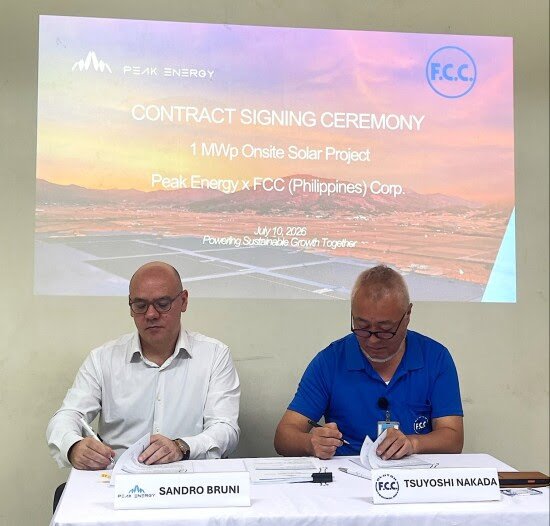
FCC (Philippines) Corp., a subsidiary of Japan’s FCC CO., LTD. and one of the world’s leading manufacturers of motorcycle clutch systems, has entered into a 15-year renewable energy agreement with Peak Energy to power its manufacturing facility in Laguna through an onsite solar installation.
The partnership marks a significant step in FCC Philippines’ sustainability journey while improving the company’s operational efficiency and long-term energy resilience. Under the agreement, Peak Energy will design, finance, construct, own, and operate a 1 MWp rooftop solar power system, enabling FCC Philippines to purchase clean electricity without any upfront capital investment.
The solar installation is expected to generate approximately 1,500 MWh of renewable electricity during its first year, providing power at a price nearly 30% lower than grid electricity tariffs. The project is also projected to reduce approximately 650 tonnes of CO₂ emissions annually, equivalent to avoiding the consumption of nearly 252,000 litres of gasoline each year.
FCC CO., LTD. commands more than 50% of the global motorcycle clutch market and supplies clutch systems and automotive components to major global manufacturers, including Honda, Yamaha, Suzuki, Kawasaki, Ford, Harley-Davidson, BMW and several other leading automotive brands. The company has maintained manufacturing operations in the Philippines since 1993, serving both two-wheel and four-wheel mobility sectors.
The agreement comes as automotive supply chains worldwide increasingly prioritize decarbonization and lower embedded carbon emissions. By integrating renewable energy into its operations, FCC Philippines aims to strengthen its competitiveness while supporting the broader sustainability objectives of global automotive manufacturers.
Peak Energy will oversee the complete lifecycle of the project, including engineering, financing, construction, operations, and maintenance. This allows FCC Philippines to access stable, lower-cost renewable energy while eliminating investment risks associated with owning the solar infrastructure.
The collaboration also reinforces Peak Energy’s growing presence among Japanese industrial manufacturers across Asia. The renewable energy developer has previously partnered with companies such as JTEKT (Toyota Group), AICA Thailand, and Yokogawa Singapore, delivering industrial solar solutions designed to meet the stringent engineering and quality expectations of Japanese corporations.
As the Philippines accelerates its clean energy transition with a national target of 35% renewable energy generation by 2030, industrial companies are increasingly seeking cost-effective alternatives to conventional grid electricity.
Commenting on the partnership, Gavin Adda, CEO of Peak Energy, said industrial customers are looking for electricity that is both more affordable than grid power and protected from volatile imported fuel prices. He noted that the project provides both economic and environmental benefits while supporting industrial competitiveness.
Tsuyoshi Nakada, President of FCC (Philippines) Corp., stated that the solar installation represents another milestone in the company’s commitment to achieve carbon neutrality by 2050, with an interim target of reducing carbon emissions by 50% by 2030. He added that the partnership with Peak Energy supports FCC’s long-term environmental goals while strengthening the resilience of its manufacturing operations.
The project demonstrates how renewable energy investments are becoming an integral part of modern industrial manufacturing, enabling companies to lower operating costs, reduce carbon emissions, and build more sustainable global supply chains.