
Fire Resistant Fabrics Market to Reach USD 6.63 Billion by 2034, Driven by Industrial Safety Demand
Technical Textiles Market News
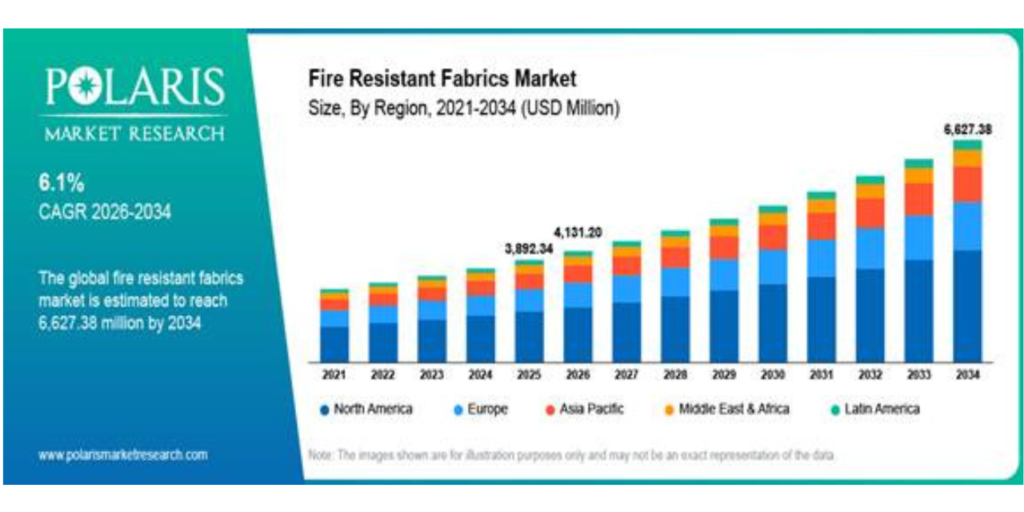
The global fire resistant fabrics market is projected to grow steadily over the next decade, fueled by stricter workplace safety regulations, rising industrial fire hazards, and continuous advancements in flame-retardant textile technologies. According to a new report by Polaris Market Research, the market is expected to expand from USD 3.67 billion in 2024 to USD 6.63 billion by 2034, registering a compound annual growth rate (CAGR) of 6.1% during the forecast period.
The market is estimated to reach USD 3.89 billion in 2025, reflecting sustained demand across industries requiring advanced personal protective equipment (PPE).
Industrial Safety Regulations Drive Market Growth
Fire resistant fabrics have become an essential component of protective clothing across industries such as oil & gas, chemicals, manufacturing, utilities, construction and defense. Increasingly stringent workplace safety standards are encouraging employers to adopt certified flame-resistant apparel to protect workers from heat, flames and molten metal exposure.
Growing awareness of occupational safety, coupled with the financial impact of workplace accidents, is prompting industries to invest in high-performance protective textiles that improve worker safety while ensuring regulatory compliance.
Treated Fabrics Dominate, Inherent Fabrics Gain Momentum
The market comprises two primary categories: treated fire resistant fabrics, which achieve flame resistance through chemical finishes, and inherent fire resistant fabrics, where protection is built directly into the fibre structure.
Treated fabrics accounted for the largest market share in 2024 due to their widespread adoption in automotive, defense and industrial applications where cost-effective flame protection is required.
Meanwhile, inherent fire resistant fabrics are witnessing growing demand in high-risk environments requiring long-lasting protection without performance degradation over time.
Among end-use industries, the industrial safety segment is expected to record the fastest growth through 2034 as companies continue investing in flame-resistant workwear and protective solutions.
Asia Pacific Leads Global Market
Asia Pacific held the largest market share of 37.2% in 2024, supported by rapid industrialisation and expanding manufacturing, healthcare, mining and chemical sectors across China, India, Japan and South Korea.
North America is forecast to register the fastest growth over the coming years, driven by expanding oil & gas operations, chemical manufacturing and stricter occupational safety requirements across industrial workplaces.
Innovation Shapes Next Generation of Protective Textiles
Technological innovation is becoming a major competitive differentiator within the fire resistant fabrics industry.
Manufacturers are increasingly incorporating nanotechnology, metal nanoparticles and clay minerals into textile structures to enhance thermal resistance without compromising flexibility or comfort.
Advanced phase-change materials are also being integrated into protective fabrics to improve heat regulation, making garments more comfortable for firefighters and industrial workers operating in extreme environments.
Recent product developments include:
- DuPont’s Nomex® Nano Flex, launched in 2025, offering improved thermal protection, enhanced mobility and superior particulate blocking.
- Teijin Limited’s Tenax, a carbon fibre-based material engineered for high heat, impact and fatigue resistance.
- Royal TenCate’s Tecasafe 360, combining inherent flame resistance with stretch performance for greater wearer comfort.
Major Companies Strengthen Innovation Focus
The market remains moderately consolidated, with leading manufacturers investing in product innovation and sustainable flame-retardant technologies.
Key industry participants include:
- DuPont
- Teijin Limited
- Huntsman International LLC
- Royal TenCate N.V.
- PBI Fibers International
- Solvay S.A.
- Kaneka Corporation
- Lenzing AG
- Newtex Industries, Inc.
- Gun Ei Chemical Industry Co., Ltd.
Many companies are expanding their portfolios through research and strategic partnerships while developing environmentally friendly flame-retardant solutions to meet evolving global regulations.
Outlook
As governments strengthen workplace safety standards and industries continue prioritising worker protection, demand for fire resistant fabrics is expected to remain robust. Although higher production costs remain a challenge, ongoing advances in fibre engineering, coating technologies and sustainable materials are expected to improve cost efficiency and broaden adoption across multiple industrial sectors.