
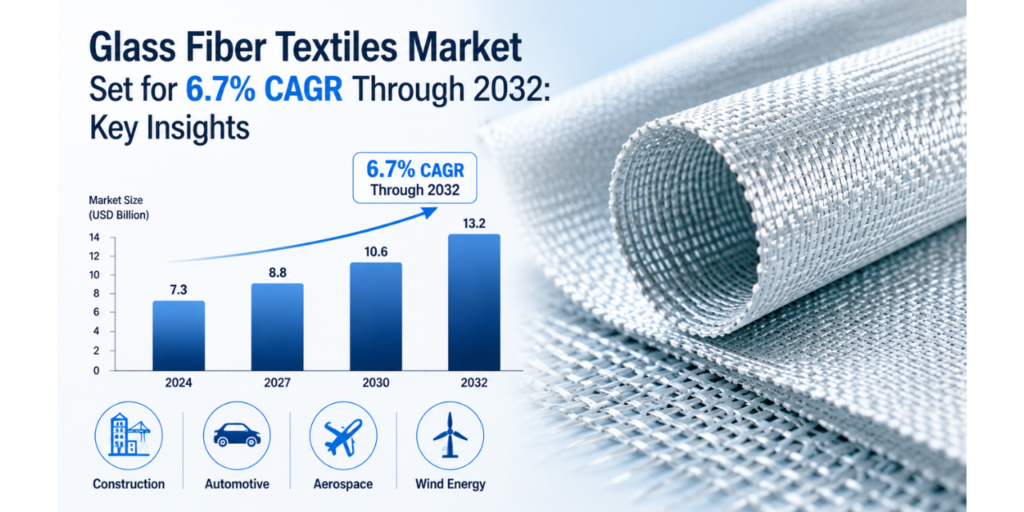
The global glass fiber textiles industry is experiencing strong expansion in 2026 as industries increasingly demand lightweight, heat-resistant, and high-strength materials. The market is benefiting from rapid growth in construction, automotive manufacturing, renewable energy, and electronics production worldwide.
Glass fiber textiles are engineered fabrics made from woven or non-woven glass fibers. These materials are widely used in insulation, reinforced composites, roofing systems, circuit boards, and wind turbine blades. Between 2021 and 2025, global demand increased significantly due to infrastructure modernization and electric vehicle adoption.
According to market insights published by Dataintelo In 2025, the global glass fiber textiles market was valued at approximately USD 18.7 billion and is projected to reach nearly USD 29.4 billion by 2032, growing at a CAGR of 6.7%.
Key Statistics at a Glance
| Metric | Value | Year |
| Global market size | USD 18.7 billion | 2025 |
| Forecast market value | USD 29.4 billion | 2032 |
| CAGR | 6.7% | 2025–2032 |
| Asia-Pacific market share | 46% | 2025 |
| Construction sector share | 31% | 2025 |
| Automotive demand growth | 8.2% YoY | 2024 |
| Wind energy growth rate | 11.4% | 2023–2025 |
| China production share | 38% | 2025 |
| Heat resistance capacity | Up to 550°C | 2025 |
| Production cost increase | 9.3% | 2022–2024 |
Rising Demand Across Major Industries
Construction Sector Leads Global Consumption
The construction industry accounted for nearly 31% of total glass fiber textile demand in 2025. Fiberglass mesh and reinforced fabrics are increasingly used in roofing, waterproofing, thermal insulation, and cement reinforcement systems.
Between 2021 and 2025, demand for fiberglass reinforcement materials in infrastructure projects increased by 27%. Builders prefer these materials because they reduce crack formation in concrete structures by nearly 40% compared to traditional reinforcement methods.
Automotive Industry Expands Usage by Double Digits
Automotive manufacturers are rapidly adopting glass fiber textiles to reduce vehicle weight and improve fuel efficiency.
Recent industry benchmarks show:
• Door panel weight reduced by 18%
• Roof structure weight reduced by 22%
• EV battery enclosure weight reduced by 20%
In 2024, electric vehicle manufacturers increased fiberglass composite procurement by 14.6% compared to 2023. Lightweight materials can improve EV driving range by approximately 6–8%, making glass fiber textiles increasingly valuable for battery-powered vehicles.
Wind Energy Sector Accelerates Growth
Renewable energy is becoming one of the fastest-growing applications for glass fiber textiles. Over 75% of wind turbine blades manufactured in 2025 used fiberglass composite layers.
The wind energy segment recorded an estimated CAGR of 11.4% between 2023 and 2025. Average turbine blade lengths now exceed 85 meters, increasing fiberglass material consumption per turbine by nearly 12% since 2022.
Regional Market Performance in 2025
Asia-Pacific remains the dominant regional market with approximately 46% global market share.
| Region | Market Share |
| Asia-Pacific | 46% |
| North America | 24% |
| Europe | 21% |
| Latin America | 4% |
| Middle East & Africa | 5% |
China accounted for nearly 38% of global production output in 2025 due to large-scale manufacturing capacity and lower operational costs. India also recorded strong growth, with domestic demand increasing by 9.1% in 2024 driven by infrastructure and industrial expansion.
Technology Improvements Boost Performance
Manufacturers are investing heavily in advanced production technologies to improve product quality and efficiency.
Compared to 2018 production standards:
• Tensile strength improved by 30%
• Thermal stability increased by 21%
• Moisture resistance improved by 18%
• Manufacturing waste reduced by 12%
Modern glass fiber textiles can withstand temperatures up to 550°C, making them suitable for aerospace insulation, industrial filtration, and high-temperature electrical applications.
Cost and Sustainability Trends
Between 2022 and 2024, manufacturers faced rising operational expenses:
| Cost Factor | Increase |
| Energy costs | 18% |
| Raw silica prices | 11% |
| Transportation costs | 9% |
| Labor costs | 6% |
Despite cost pressures, sustainability initiatives are improving industry efficiency. Many manufacturers now use 70–85% recyclable material content and have reduced furnace emissions by approximately 19% since 2020.
Automation adoption also reduced labor dependency by nearly 22% in large manufacturing facilities by 2025.
Future Outlook Through 2032
The long-term outlook for the glass fiber textiles industry remains highly positive. Increasing investments in smart infrastructure, renewable energy, aerospace manufacturing, and electric vehicles are expected to sustain global demand.
By 2032, the market is projected to surpass USD 29.4 billion with strong growth across Asia Pacific and North America. Wind energy applications are expected to grow above 10% annually, while EV-related fiberglass demand could more than double by 2030.
With measurable improvements in strength, recyclability, and production efficiency, glass fiber textiles are becoming one of the most important advanced industrial materials in the global manufacturing sector. Read A Full Report: https://dataintelo.com/report/glass-fiber-textiles-market