
Mumbai: India’s textile industry could be entering a new phase of sustained growth, according to a sector initiation report released by Emkay Global Financial Services.
The brokerage has initiated coverage on the textile sector with BUY recommendations on Arvind Ltd, Nitin Spinners, and Sanathan Textiles, citing a combination of favorable policy support, global trade opportunities, and strengthening domestic demand.The report suggests that India is approaching an inflection point in its textile journey after years of losing market share in global apparel trade. Despite being one of the world’s largest textile producers, India’s share in global apparel exports has remained largely stagnant at around 3-4 percent over the past fifteen years.
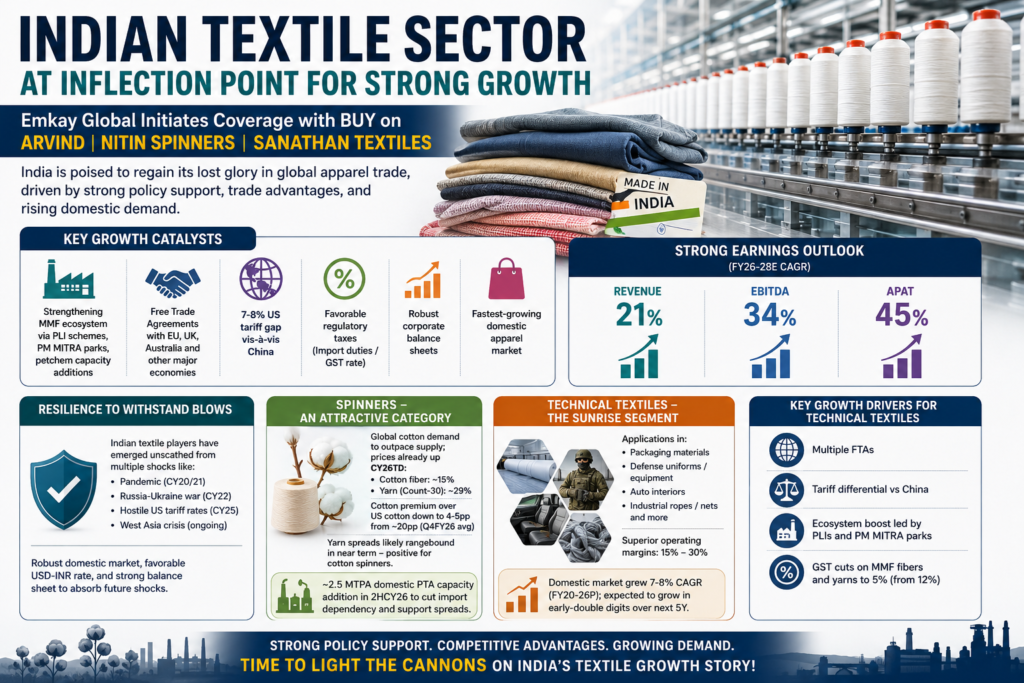
Multiple Growth Catalysts Emerging
Emkay Global believes several structural factors are now aligning in India’s favor. These include the strengthening of the domestic man-made fibre (MMF) ecosystem through Production Linked Incentive (PLI) schemes, PM MITRA textile parks, and expanding petrochemical capacities.
The brokerage also highlighted the importance of India’s ongoing and proposed Free Trade Agreements (FTAs) with major economies such as the European Union, the United Kingdom, and Australia. These agreements are expected to improve market access and enhance export competitiveness.
Another key advantage is the tariff differential between India and China in the United States market. Indian exporters currently enjoy a 7-8 percent tariff advantage over Chinese competitors, creating opportunities for market share gains.
Additional support comes from favorable tax structures, strong corporate balance sheets, and the rapid expansion of India’s domestic apparel market, which remains one of the fastest-growing globally.
Based on these drivers, Emkay expects its textile coverage universe to deliver revenue, EBITDA, and profit after tax CAGR of 21 percent, 34 percent, and 45 percent respectively between FY26 and FY28.
Industry Demonstrates Strong Resilience
The report notes that Indian textile manufacturers have successfully navigated several major disruptions over the past few years, including the COVID-19 pandemic, the Russia-Ukraine conflict, and shifting global tariff structures.
According to Emkay, the ongoing geopolitical tensions in the Middle East may create short-term challenges through higher logistics and energy costs. However, the brokerage expects these pressures to ease once conditions stabilize.
A robust domestic consumption market, favorable currency dynamics, and healthier corporate balance sheets are expected to help textile companies absorb future shocks more effectively.
Cotton Spinners Positioned for Growth
The report identifies cotton spinning as one of the most attractive segments within the textile value chain.
Global cotton demand is expected to exceed supply in the upcoming season due to weather-related production risks, including the impact of El Niño and lower water reservoir levels in key growing regions.
Domestic cotton fibre and yarn prices have already shown significant strength during 2026, while the premium of Indian cotton over US cotton has narrowed considerably. Emkay believes current yarn spreads are likely to remain stable, providing favorable profitability conditions for spinning companies.
Meanwhile, polyester value chains are expected to benefit from easing raw material pressures and the addition of approximately 2.5 million tonnes per annum of domestic PTA capacity in the second half of 2026, reducing import dependence and improving cost structures.
Technical Textiles Emerge as a High-Growth Opportunity
The report also highlights technical textiles as one of the most promising segments within the industry.
Technical textiles are used across diverse sectors including packaging, defense, automotive interiors, industrial applications, filtration, and healthcare. These products typically generate higher operating margins ranging between 15 and 30 percent.
India’s technical textiles market has already recorded a CAGR of 7-8 percent over the last six years. Emkay expects growth to accelerate into double digits over the next five years.
The outlook is supported by expanding free trade agreements, favorable tariff positioning against China, government-backed incentives under PLI and PM MITRA schemes, and GST reductions on MMF fibres and yarns.
Outlook Remains Positive
As global supply chains continue to diversify and international buyers seek alternative sourcing destinations, India appears well-positioned to strengthen its role in global textile and apparel manufacturing.
With supportive government policies, expanding infrastructure, growing domestic demand, and increasing competitiveness across multiple product categories, the Indian textile sector could be entering one of its strongest growth phases in recent years.
Industry stakeholders and investors will be closely watching how these structural advantages translate into export gains, capacity expansion, and earnings growth over the coming years.