
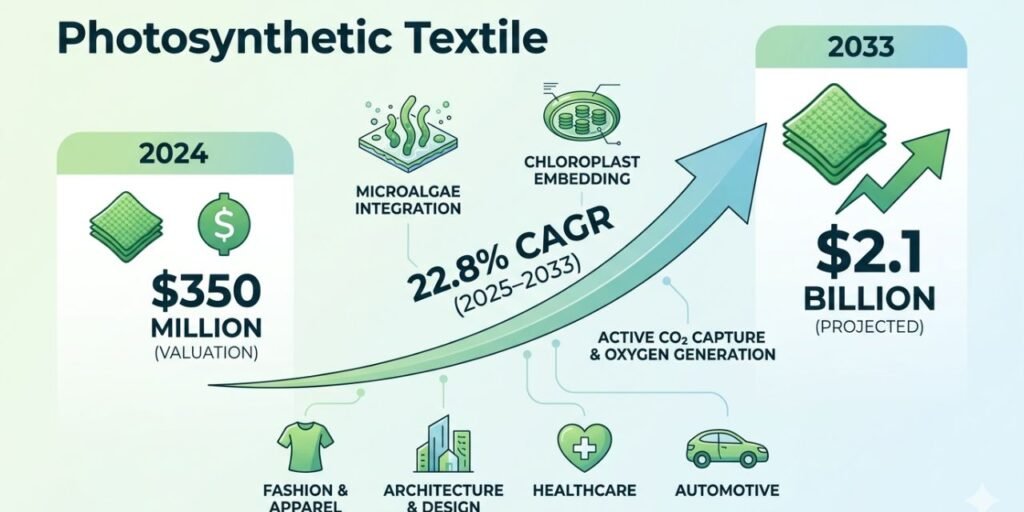
The global photosynthetic textile market, a niche yet rapidly evolving segment within sustainable and bio-functional fabrics, was valued at USD 350 million in 2024 and is projected to reach USD 2.1 billion by 2033, expanding at a CAGR of 22.8% between 2025 and 2033, according to Marketintelo.
This strong growth trajectory highlights the increasing demand for textiles capable of capturing CO₂, improving air quality, and generating oxygen through integrated photosynthetic systems. Once limited to experimental research, these innovative materials are now gaining traction across fashion, healthcare, automotive, and architectural applications, supported by sustainability regulations and climate-focused initiatives.
Key Market Figures (2024)
- Market Size: USD 350 million
- Forecast Value (2033): USD 2.1 billion
- CAGR (2025–2033): 22.8%
- Historical Data Range: 2018–2023
- Regions Covered: North America, Europe, Asia Pacific, Latin America, Middle East & Africa
Market Evolution and Growth Trends (2018–2033)
The market began with early-stage developments between 2018 and 2020, with accelerated growth observed from 2021 onward as investments and sustainability policies intensified.
Year-wise Market Growth:
- 2018: $30M
- 2019: $48M (+60%)
- 2020: $80M (+67%)
- 2021: $115M (+44%)
- 2022: $155M (+35%)
- 2023: $245M (+58%)
- 2024: $350M (+43%)
Key Insights:
- 2020–2021: Transition from pilot projects to commercial adoption
- 2021–2022: Continued growth despite global disruptions
- 2023–2024: Expansion into healthcare and architectural sectors
Regional Market Distribution (2024)
The market shows varied adoption patterns across regions:
- Europe: ~38% (~$133M)
- Asia Pacific: ~30% (~$105M)
- North America: ~20% (~$70M)
- Latin America: ~6% (~$21M)
- Middle East & Africa: ~6% (~$21M)
Regional Highlights:
- Europe leads due to strict environmental regulations and Green Deal initiatives
- Asia Pacific is expected to record the fastest growth, with a 27.4% CAGR, driven by industrial expansion and air-quality concerns
- North America continues steady growth supported by innovation and consumer demand
Technology and Product Insights
The market is segmented based on integration technologies and product types:
Technology Share (2024):
- Microalgae Integration: ~44%
- Chloroplast Embedding: ~28%
- Biofilm Coating: ~18%
- Others: ~10%
Product Distribution:
- Synthetic Fiber-based: ~48%
- Natural Fiber-based: ~32%
- Blended: ~20%
Synthetic fibers such as polyester and nylon dominate due to their ease of processing and compatibility with bio-integration technologies.
Application Areas and Industry Adoption
Photosynthetic textiles are increasingly being used across multiple sectors:
- Fashion & Apparel: ~41%
- Healthcare: ~22%
- Architecture & Interiors: ~18%
- Automotive: ~12%
- Others: ~7%
Key Use Cases:
- Apparel incorporating microalgae to reduce carbon footprint
- Healthcare textiles offering antimicrobial and healing properties
- Architectural fabrics improving indoor air quality
Competitive Landscape
The market includes a mix of startups and established players driving innovation:
- AlgiKnit (microalgae-based fibers)
- Living Ink Technologies (bio-based coatings)
- Green Fabric Labs (chloroplast integration)
- BioLogic Studio (responsive living textiles)
Large companies such as Nike, Adidas, BASF, and DuPont are also exploring bio-integrated textile solutions as part of their sustainability strategies.
Key Challenges
Despite strong growth prospects, the industry faces several constraints:
- Regulatory and certification gaps (~22%)
- High production costs (~30% higher than conventional textiles)
- Shortage of skilled professionals (~18%)
Policy and Government Support
Government initiatives are playing a critical role in market expansion:
- European Green Deal investments exceeding €50 billion
- Asia Pacific subsidies for green manufacturing increasing by 12–15% annually
Regions with strong policy backing are witnessing 2–3 times higher adoption rates compared to others.
Future Outlook (2025–2033)
Projected market values indicate sustained growth:
- 2025: ~$510M
- 2026: ~$650M
- 2028: ~$980M
- 2030: ~$1.05B
- 2033: ~$2.1B
With a CAGR of 22.8%, this segment significantly outpaces traditional textile markets.
Conclusion
The photosynthetic textile market is emerging as one of the most dynamic segments within the textile industry. Growing from $350 million in 2024 to $2.1 billion by 2033, it reflects a strong shift toward sustainable, bio-integrated materials.
Driven by technological advancements, supportive policies, and expanding applications, photosynthetic textiles are set to play a crucial role in the future of climate-responsive and high-performance textile solutions.