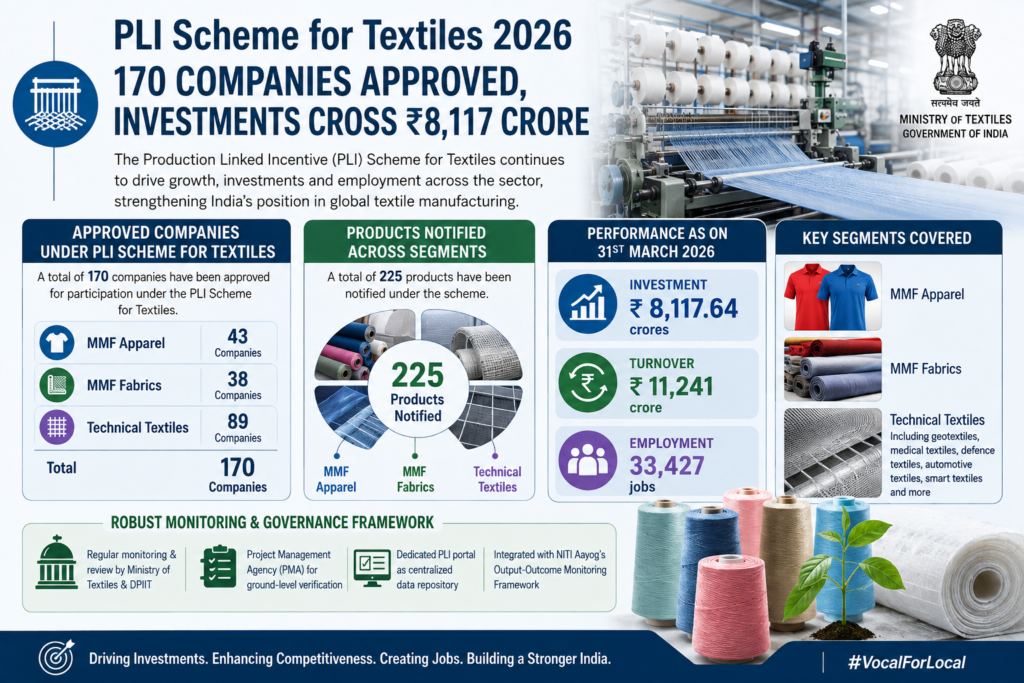
The Production Linked Incentive (PLI) Scheme for Textiles continues to strengthen India’s manufacturing ecosystem, with a total of 170 companies approved across the MMF Apparel, MMF Fabrics, and Technical Textiles segments, according to information shared by Minister of State for Textiles, Shri Pabitra Margherita, in a written reply in the Lok Sabha.
The approved companies include 43 in MMF Apparel, 38 in MMF Fabrics, and 89 in Technical Textiles, highlighting the government’s continued focus on expanding value-added textile manufacturing and promoting investments in high-growth segments.
The minister stated that 225 products have been notified under the scheme, covering a wide range of products across the three categories. These include man-made fibre garments, woven and knitted fabrics, geotextiles, medical textiles, protective textiles, automotive textiles, sports textiles, composites, defence textiles, smart textiles, and several other high-performance applications.
As of March 31, 2026, the scheme has delivered significant progress, generating:
Investment: ₹8,117.64 crore
Turnover: ₹11,241 crore
Employment: 33,427 jobs
The government has established a multi-layered monitoring mechanism to ensure effective implementation of the scheme. Regular reviews are being conducted by the Ministry of Textiles and the Department for Promotion of Industry and Internal Trade (DPIIT), which serves as the nodal department for all PLI schemes.
To strengthen transparency and accountability, a Project Management Agency (PMA) has been appointed to conduct rigorous ground-level verification. Additionally, a dedicated PLI portal has been developed to act as a centralized repository for scheme-related data and performance indicators.
The scheme has also been integrated with NITI Aayog’s Output-Outcome Monitoring Framework, enabling continuous assessment of investments, production growth, and employment generation.
The Technical Textiles segment has emerged as the largest beneficiary, accounting for 89 approved companies. The notified products include geotextiles, medical textiles, defence textiles, automotive textiles, protective clothing, carbon fibres, aramid fibres, glass fibres, composites, smart textiles, and industrial protection products.
The latest figures indicate that the PLI Scheme for Textiles is accelerating domestic manufacturing, attracting private investments, creating employment opportunities, and strengthening India’s position in the global market for value-added textiles and technical textile products.