
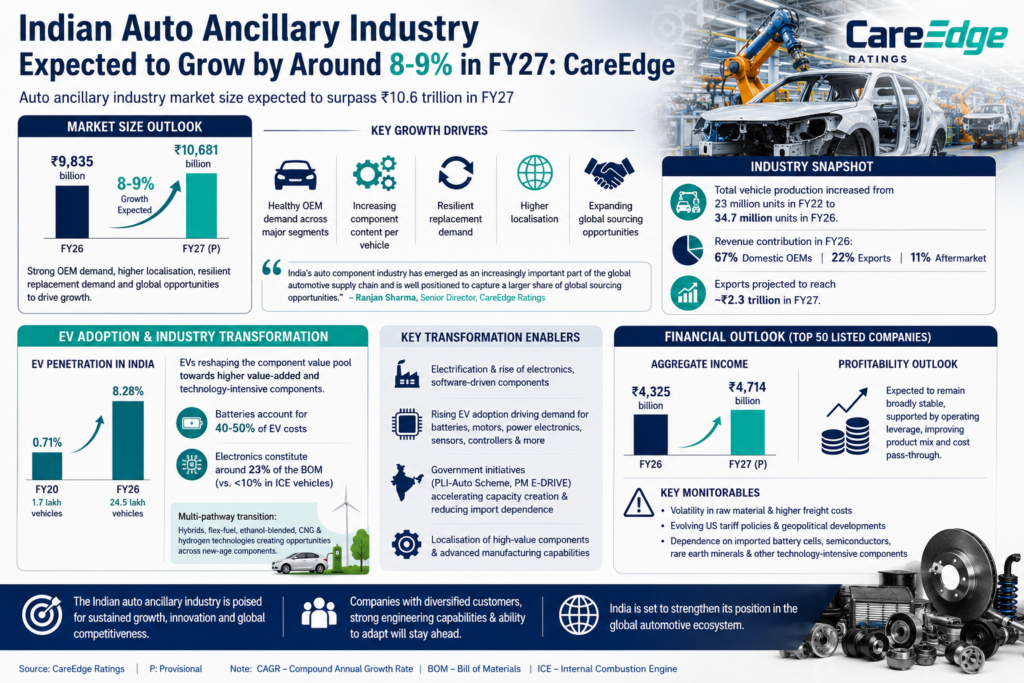
India’s auto ancillary industry is expected to maintain strong growth momentum in FY27, with the market projected to expand by 8–9%, according to a new report by CareEdge Ratings.
The report estimates that the industry’s market size will increase from ₹9,835 billion in FY26 to ₹10,681 billion in FY27, driven by robust demand from original equipment manufacturers (OEMs), increasing component content per vehicle, higher localisation, resilient replacement demand, and expanding global sourcing opportunities.
Industry Entering an Investment-Led Growth Phase
CareEdge Ratings noted that the Indian auto component industry is entering a sustained investment-led growth cycle, supported by rising domestic vehicle production and greater value addition across the automotive supply chain.
The transition toward electronics-intensive and cleaner mobility platforms is creating new opportunities for component manufacturers, while government-backed localisation initiatives are helping reduce dependence on imports.
The report also highlighted that the industry’s established cost pass-through mechanisms with OEMs and improving operational efficiencies are helping maintain earnings stability.
However, technological adaptation, import dependence on critical components, and changing global trade policies remain key challenges for the sector.
Vehicle Production Continues to Rise
India’s automotive industry has witnessed strong growth in recent years.
According to CareEdge Ratings, total vehicle production increased from 23 million units in FY22 to 34.7 million units in FY26, reflecting healthy growth across multiple vehicle segments.
Domestic OEMs continued to dominate the industry, contributing around 67% of total revenues in FY26, while exports accounted for 22% and the aftermarket contributed 11%.
The growing popularity of SUVs and premium vehicles, combined with stricter emission and safety regulations, is also increasing the value of components required in each vehicle.
Auto Component Exports to Reach ₹2.3 Trillion
India’s increasing integration into global automotive supply chains is expected to create additional growth opportunities for component manufacturers.
The report projects that auto component exports will rise to approximately ₹2.3 trillion in FY27, strengthening India’s position as a global manufacturing hub.
Commenting on the report, Ranjan Sharma, Senior Director at CareEdge Ratings, said:
“India’s auto component industry has emerged as an increasingly important part of the global automotive supply chain, supported by its manufacturing competitiveness, engineering capabilities, and expanding domestic market.”
He added that continued progress in the localisation of critical components and the development of advanced manufacturing capabilities would be essential for enhancing value addition and strengthening India’s long-term competitiveness.
EV Adoption Is Reshaping the Industry
Electric vehicle adoption in India continues to accelerate rapidly.
According to the report, annual EV registrations increased from 1.7 lakh vehicles in FY20 to 24.5 lakh vehicles in FY26, while EV penetration rose from 0.71% to 8.28% during the same period.
The two-wheeler and three-wheeler segments have been the primary drivers of this growth.
The transition toward electric mobility is also reshaping the industry’s value chain by increasing demand for technology-intensive components.
The report highlighted that:
- Batteries account for 40–50% of EV costs.
- Electronics contribute around 23% of an EV’s bill of materials.
- Electronics account for less than 10% of conventional internal combustion engine (ICE) vehicles.
As a result, demand is expected to increase for:
- Batteries
- Electric motors
- Power electronics
- Semiconductors
- Sensors
- Electronic control units
- Thermal management systems
- Embedded software
India’s Mobility Future Will Be Multi-Pathway
While electric vehicles will remain an important growth driver, CareEdge Ratings believes India’s mobility transition will not depend on a single technology.
The country’s future automotive landscape is expected to include:
- Hybrid vehicles
- Flex-fuel vehicles
- Ethanol-powered vehicles
- CNG vehicles
- Hydrogen-based mobility solutions
This diversified approach is expected to create new opportunities across fuel systems, emission-control technologies, advanced electronics, lightweight materials, and software-driven automotive components.
Government Policies Supporting Industry Growth
Government initiatives such as the PLI-Auto Scheme and the PM E-DRIVE Scheme are expected to accelerate domestic manufacturing and reduce dependence on imported technologies.
According to Arti Roy, Associate Director at CareEdge Ratings, companies with diversified product portfolios, strong engineering capabilities, wider customer relationships, and prudent capital allocation strategies will be better positioned to benefit from the industry’s transformation.
Top 50 Listed Companies Expected to Maintain Strong Performance
The report also forecasts healthy financial performance for India’s top 50 listed auto ancillary companies.
Aggregate industry income is expected to increase from ₹4,325 billion in FY26 to ₹4,714 billion in FY27, while profitability is expected to remain stable due to:
- Operating leverage
- Better product mix
- Effective cost pass-through mechanisms
However, challenges such as raw material price volatility, rising freight costs, geopolitical uncertainties, evolving US tariff policies, and continued dependence on imported battery cells, semiconductors, and rare earth materials will continue to influence the industry’s outlook.