
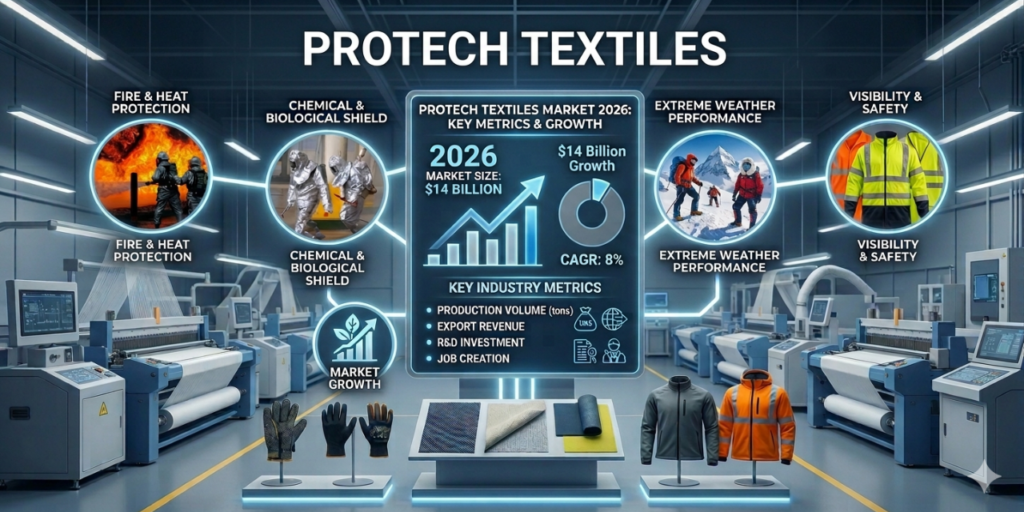
The global Protech textiles market is witnessing a significant transformation, fueled by rising safety regulations, technological advancements, and increasing industrial risk awareness. The industry is transitioning from traditional protective fabrics to advanced, performance-oriented textile solutions that deliver measurable improvements in safety, durability, and efficiency.
According to Dataintelo, the market was valued at approximately USD 8.9 billion in 2024 and is projected to reach between USD 13.6 billion and USD 14.2 billion by 2030, registering a compound annual growth rate (CAGR) of 7.2%–8.1%. This growth is increasingly linked to quantifiable performance metrics such as heat resistance, tensile strength, and product lifespan.
Market Growth and Performance Advancements
Between 2020 and 2024, the market expanded from USD 6.7 billion to USD 8.9 billion, reflecting a growth of over 32%. This increase highlights the growing adoption of high-performance protective materials across industries including oil & gas, defense, and healthcare.
Modern Protech textiles are engineered to deliver measurable performance outcomes. For example, advanced flame-resistant fabrics can endure temperatures exceeding 1,000°C for short durations, while ballistic materials have significantly improved impact absorption capabilities. Enhancements in durability, reduced weight of protective gear, improved UV resistance, and extended chemical resistance are contributing to better operational efficiency and reduced replacement costs.
Application-Based Demand Trends
Demand varies across sectors, with industrial applications leading the market, followed by defense, healthcare, and construction. The industrial segment accounts for the largest share, while defense and law enforcement continue to see steady growth due to increased adoption of protective equipment such as bulletproof vests.
The healthcare segment is expanding rapidly, supported by sustained demand for personal protective equipment (PPE) and increased use of antimicrobial textiles. Similarly, construction and firefighting applications are witnessing steady growth driven by stricter safety compliance requirements.
Regional Insights
Asia-Pacific dominates the global market, supported by rapid industrialization and stringent safety regulations. The region accounts for the largest share and is expected to maintain its leadership through 2030, driven by strong manufacturing growth in emerging economies.
North America and Europe also hold significant shares, with growth supported by increased defense spending, sustainability initiatives, and adoption of advanced textile technologies.
Key Growth Drivers
The market’s expansion is supported by several key factors, including stricter workplace safety regulations, increased global defense expenditure, and the continued growth of the healthcare sector. The rising adoption of smart textiles, which integrate advanced technologies for monitoring and safety, is also contributing significantly to market growth.
Additionally, increased awareness of industrial risks and the benefits of preventive investments is driving demand for high-performance protective solutions.
Cost Dynamics and Challenges
The market is also influenced by rising production costs, driven by increased prices of raw materials such as aramid and carbon fibers, as well as higher labor and processing expenses. As a result, advanced protective textiles are priced higher than conventional alternatives. However, their longer lifespan and improved performance often justify the higher initial investment.
Despite positive growth trends, challenges remain. High costs limit adoption among small and medium-sized enterprises, while supply chain disruptions and sustainability concerns continue to impact the industry. Currently, only a portion of products are recyclable, highlighting the need for further innovation in sustainable materials.
Future Outlook
Looking ahead, the Protech textiles market is expected to exceed USD 14 billion by 2030, offering substantial growth opportunities. The adoption of smart textiles is projected to increase significantly, while Asia-Pacific is expected to strengthen its dominance.
Advancements such as AI-enabled textiles are anticipated to enhance real-time safety monitoring and further improve efficiency. Overall, the market is evolving into a data-driven ecosystem where investment decisions are increasingly based on measurable improvements in safety, performance, and cost-effectiveness.
Conclusion
The Protech textiles market is on a strong growth trajectory, supported by continuous innovation and increasing demand for high-performance protective solutions. As industries prioritize safety, efficiency, and sustainability, advanced Protech textiles will play a critical role in shaping the future of industrial and protective applications.