
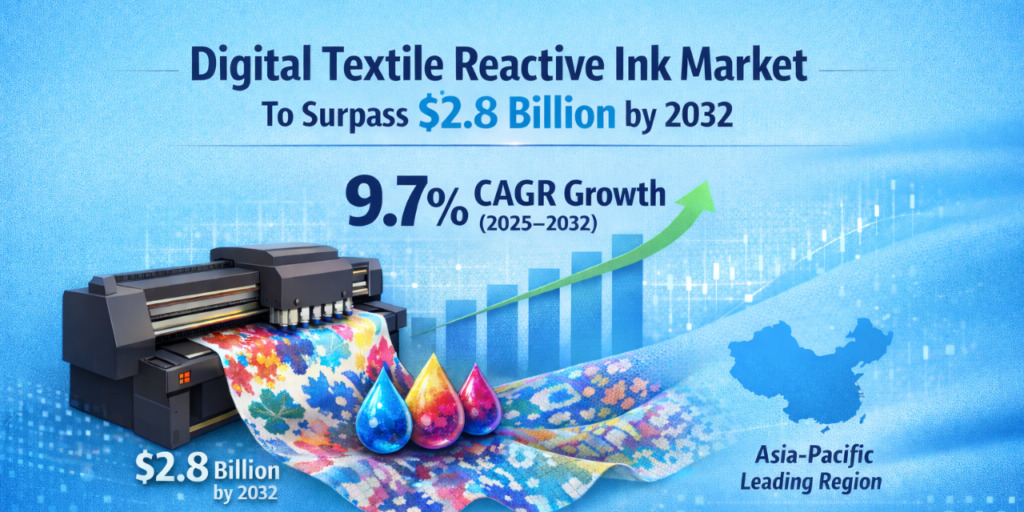
The global digital textile reactive ink market is experiencing significant expansion, supported by the rapid adoption of digital textile printing technologies. According to recent insights from Marketintelo, the market was valued at approximately USD 1.45 billion in 2024, up from USD 1.32 billion in 2023, reflecting a year-on-year growth of 9.8%. It is projected to reach between USD 2.8 billion and USD 3.1 billion by 2032, registering a compound annual growth rate (CAGR) of 9.5%–9.7% during the forecast period. This growth is primarily driven by increasing demand for sustainable printing solutions and the ongoing digital transformation of the apparel industry.
Market Evolution and Historical Growth
Over the past decade, the market has evolved from a niche segment into a mainstream industrial solution. From a valuation of around USD 720 million in 2016, it grew steadily to USD 1.45 billion by 2024, achieving an overall CAGR of approximately 9.2%. Despite temporary disruptions during the pandemic period, the market demonstrated resilience, recovering quickly and maintaining a consistent upward trajectory.
Recent growth trends indicate accelerating adoption, with year-on-year growth rising significantly in the latest period. This reflects increased investments in digital textile infrastructure and the development of eco-friendly ink technologies.
Key Market Drivers
The expansion of digital textile printing is a major contributor to market growth. Global printing volumes have increased substantially, supported by the widespread use of reactive inks, particularly for natural fibers such as cotton, which account for a significant share of global textile production.
Sustainability considerations are also playing a critical role. Digital reactive printing significantly reduces water consumption compared to conventional dyeing processes, aligning with stricter environmental regulations and sustainability initiatives, particularly in Europe.
In addition, the continued growth of the global apparel market is driving demand for advanced textile printing solutions, further supporting the adoption of reactive inks.
Technological and Market Advancements
Advancements in digital printing technologies have improved efficiency, reduced costs, and enhanced product quality. Digital textile printing now offers notable reductions in production costs compared to traditional methods, while also delivering significant environmental benefits, including reduced water usage.
Reactive inks account for a substantial share of the overall textile ink market, supported by their superior performance characteristics, particularly in applications involving natural fibers.
Challenges Impacting Market Growth
Despite strong growth prospects, the market faces several challenges. High initial investment costs for digital printing equipment and relatively higher prices of reactive inks compared to alternative ink types can limit adoption, particularly among small and medium-sized enterprises.
Additionally, digital printing speeds remain lower than traditional methods, and adoption levels in cost-sensitive regions are still relatively low, indicating potential barriers to widespread implementation.
Regional Insights
Asia-Pacific dominates the global market, accounting for the largest share due to its strong textile manufacturing base and increasing adoption of digital technologies. Countries such as China and India are key contributors to regional demand.
Europe remains a significant market, driven by stringent environmental regulations and sustainability initiatives, while North America continues to show steady growth supported by technological advancements and industry investments.
Other regions, including the Middle East, Africa, and Latin America, are gradually expanding their presence, supported by growing textile exports and industrial development.
Market Segmentation
The apparel segment represents the largest application area, followed by home textiles and technical textiles. Reactive inks hold a leading position within the digital textile ink category, alongside pigment, sublimation, and acid inks.
Future Outlook
The market is expected to witness continued investment in digital textile technologies, with global investments projected to exceed USD 5.5 billion by 2028. Advancements such as automation, artificial intelligence in color management, and eco-friendly ink innovations are anticipated to further enhance efficiency and sustainability.
Government initiatives supporting textile modernization and sustainability are also expected to play a key role in accelerating market growth.
Conclusion
The digital textile reactive ink market is on a strong growth trajectory, supported by clear quantitative indicators across demand, technological adoption, and sustainability benefits. With increasing digital penetration, significant cost and resource efficiencies, and strong regional growth, the market is set to play a crucial role in shaping the future of textile manufacturing.