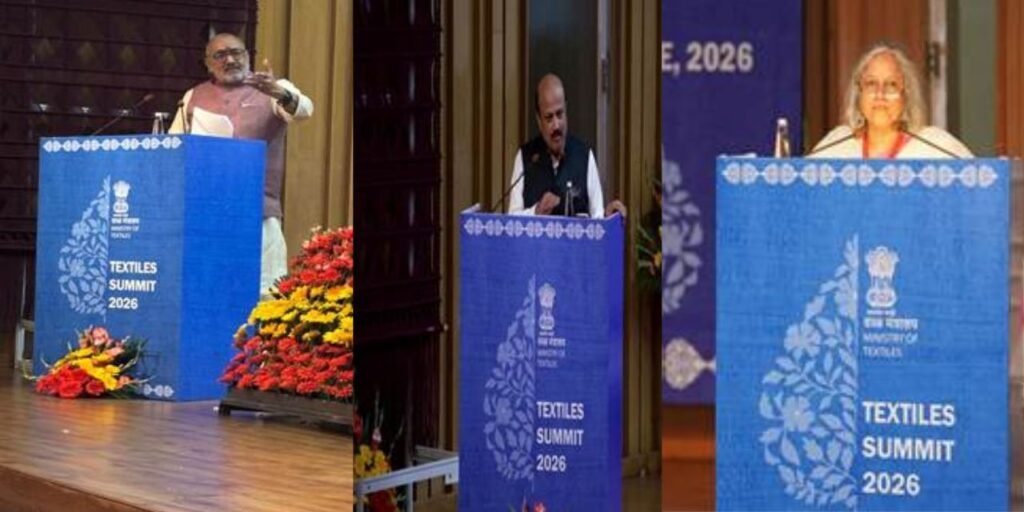
The Ministry of Textiles successfully concluded the two-day Textiles Summit 2026, held on June 23-24, bringing together representatives from State Governments, industry bodies, academia, and export stakeholders to chart a comprehensive roadmap for the growth and global expansion of India’s textile sector.
The summit served as a key platform for collaborative discussions on sustainability, export competitiveness, Free Trade Agreement (FTA) utilization, innovation, and market diversification, aligning with India’s ambitious target of achieving USD 100 billion in textile exports by 2030.
Government Calls for Action-Oriented Implementation
Addressing the concluding session, Union Minister of Textiles Giriraj Singh emphasized that the focus must now shift from planning to execution. He urged stakeholders to implement district and state-level textile development plans with a proactive approach while prioritizing value addition, product-market alignment, sustainability compliance, and niche product development.
The Minister also highlighted the importance of leveraging India’s expanding network of Free Trade Agreements to unlock new export opportunities and strengthen the country’s position in global textile markets.
National Textile Export Roadmap in the Making
In her closing remarks, Textiles Secretary Neelam Shami Rao stated that the summit marked a decisive transition from dialogue to action. She announced that recommendations received from states, districts, industry stakeholders, and Export Promotion Councils would be consolidated into a comprehensive National Textile Export Roadmap.
The roadmap will focus on promoting high-value textile segments, improving quality standards, fostering innovation, and accelerating sustainability initiatives while strengthening institutional coordination to enhance India’s global trade presence.
Leveraging FTAs for Export Growth
During a special session, Commerce Secretary Rajesh Agrawal urged the textile industry to maximize the benefits of recently concluded Free Trade Agreements at the earliest.
He stressed the need to address information gaps at the district level to ensure exporters fully understand and utilize FTA provisions. Highlighting the Government’s export promotion initiatives, Agrawal noted that the Department of Commerce has conducted over 500 workshops to raise awareness and build export capabilities.
He also encouraged States and Union Territories to actively participate in the revived Districts as Export Hubs (DEH) initiative, which aims to strengthen local export ecosystems and improve market access.
Sustainability and Quality Take Centre Stage
One of the key sessions on the summit’s second day focused on Quality, Sustainability Certifications and Sourcing Decisions, addressing critical issues shaping the future of the textile industry.
Discussions centered on translating global brand sustainability requirements into actionable state-level strategies, promoting digital product passports for enhanced traceability, and exploring closed-loop recycling systems to support circular textile production.
Participants also emphasized strengthening collaboration between municipalities and state governments for textile waste management, bridging the gap between academic research and commercial recycling technologies, simplifying sustainability compliance for MSMEs, and aligning national frameworks with evolving international regulations.
Roadmap for Export Enablement and Market Diversification
The summit’s final session focused on Export Enablement, FTA Utilisation and Market Diversification, outlining strategies to strengthen India’s textile export ecosystem.
Industry leaders, academic experts, and government representatives highlighted the importance of leveraging tariff advantages under FTAs while maintaining high sustainability and quality standards. Discussions also underscored the need to diversify export markets, attract anchor investors, and expand product offerings, particularly in the rapidly growing man-made fibre (MMF) segment.
The session further emphasized building strong in-house design capabilities, responding to changing consumer preferences, developing globally competitive MSMEs, improving export finance mechanisms, and strengthening risk mitigation frameworks.
Driving India’s Global Textile Leadership
The successful conclusion of Textiles Summit 2026 reflects the Government’s commitment to creating a globally competitive, sustainable, and innovation-driven textile sector.
With a renewed focus on sustainability, export growth, market diversification, and industry collaboration, the summit has laid the foundation for actionable strategies that will help India strengthen its position as a leading textile manufacturing and export hub while advancing toward its USD 100 billion export target by 2030.