
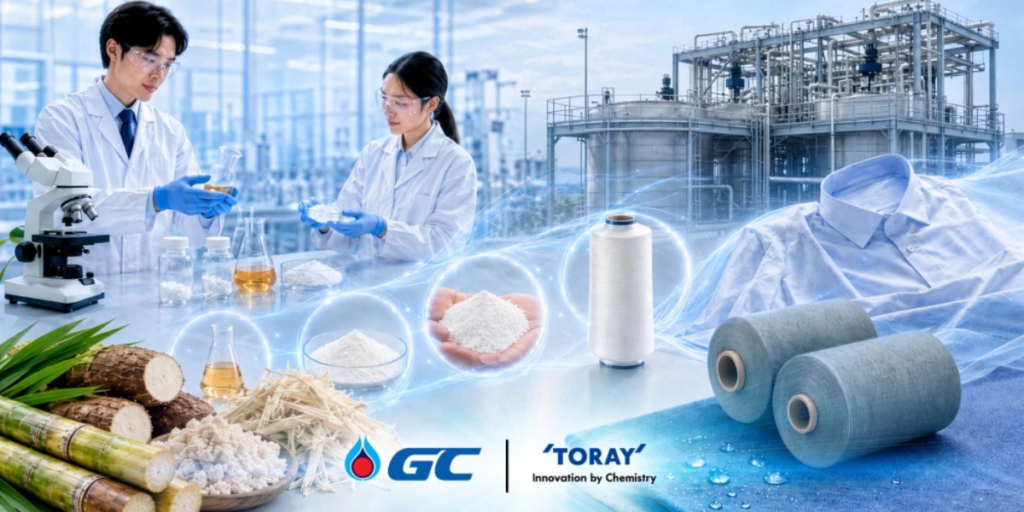
PTT Global Chemical Public Company Limited (GC) and Toray Industries, Inc. have developed a first-of-its-kind manufacturing technology for producing bio-based adipic acid from bio-muconic acid through fermentation using starch residues. The companies have also established technology for manufacturing 100% bio-based nylon 6,6 using the bio-based adipic acid.
The development comes amid growing global efforts to reduce greenhouse gas emissions and decrease dependence on fossil-based raw materials. The chemical industry is increasingly focusing on renewable biomass resources that do not compete with food supply chains.
Cassava pulp, a by-product generated during starch production from cassava, has been identified as a promising raw material due to its stable availability. By utilizing this underused agricultural residue, the process aims to reduce the likelihood of additional farmland expansion, thereby lowering the risk of indirect land use change (ILUC).
The initiative also highlights the importance of developing technologies that can convert unused biomass resources into value-added industrial products.
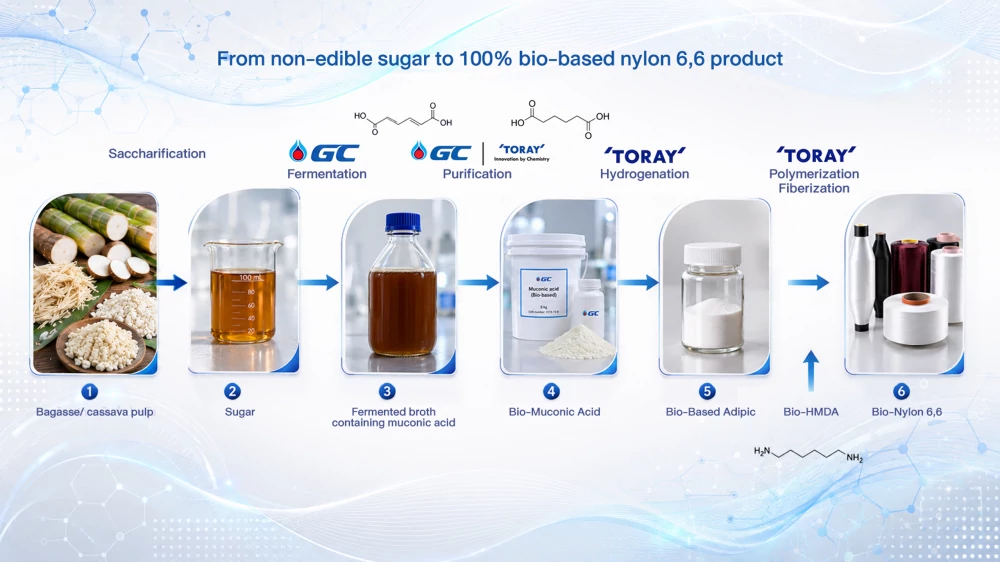
Below is an overview of the demonstration tests carried out jointly by the two companies across the integrated manufacturing process developed to establish this technology.
| Engineering | Body | Implementation details and points |
| Saccharification | Toray | We have demonstrated the production of 5 dry-tons of glucose sugar per day using 66 tons of starch residue (cassava pulp) with approximately 85% moisture as raw materials. Energy-saving and high-quality saccharification technology using separation membranes. |
| Fermentation | GC | We can stably produce a fermented broth of bio-muconic acid with high efficiency from sugars made from GC’s proprietary strain. This showed the successful validation of technology from lab through to pilot scale fermenter (approx. 50 m³). |
| Refinement | Collaboration between the two companies | High-purity bio-muconic acid is refined from the fermentation broth using the unique technology developed by both companies The high quality of refined bio-muconic acid can convert to bio-based adipic acid. |
| Chemical Conversion | Toray | Bio-based adipic acid is produced from bio-muconic acid. Ensuring the high purity quality required for Nylon 6,6 polymerization. |
| Polymerization and fibrosis | Toray | Successful polymerization and fiber processing of nylon 6,6 on a lab scale using bio-based adipic acid and bio-based hexamethylenediamine (HMDA). |
Going forward, the companies plan to scale up the production of bio-muconic acid and bio-based adipic acid. Toray also aims to establish a supply chain for textile products made using 100% bio-based nylon 6,6, with commercial sales targeted for FY2028.
GC and Toray stated that they will continue collaborating on the development and wider adoption of biomass-derived materials to support the transition toward a recycling-oriented society.
Figure: Production flow from cassava pulp (starch residue) to nylon 6,6 products
Read More: https://www.pttgcgroup.com/en/newsroom/news/1405/