

Amit Kundu
Senior Research Fellow,
Wool Research Association, Thane

Vaibhav Vankundre
Senior Scientist,
Wool Research Association

G. S. Bhati
Executive Director,
Central Wool Development Board

Dr. Mrinal Choudhari
Additional Director,
Wool Research Association
Abstract
Automotive textiles are a crucial component of modern vehicles, contributing to safety, comfort, and performance across applications such as airbags, seat belts, upholstery, and composites. The global automotive textiles market reached approximately USD 33-35 billion in 2025 and is projected to grow steadily, with a CAGR of around 3-4%. Global consumption exceeds 4.5 lakh tonnes annually, accounting for nearly 2-3% of total vehicle weight. This study highlights textile materials used in automotive applications, particularly covering fibres, yarns, fabric construction, and manufacturing techniques. With increasing emphasis on sustainability, natural fibres such as coarse wool are gaining importance due to their thermal insulation, acoustic absorption, and inherent flame-resistant properties.
1. Introduction
The automotive sector plays a vital role in economic development by enabling the efficient transportation of people and goods. However, it remains highly dependent on fossil fuels, with transportation contributing significantly to global oil consumption, estimated at over 100 million barrels per day. Increasing urbanisation, population growth, and mobility demands have led to a continuous rise in vehicle usage and energy consumption, resulting in challenges related to fuel efficiency, environmental sustainability, and traffic congestion.
Modern vehicle design has evolved significantly to meet the requirements of high performance, safety, and load-carrying capacity. However, increased vehicle weight reduces fuel efficiency, as only a small fraction of energy is effectively utilised for propulsion. Consequently, reducing vehicle mass has become a key strategy for improving energy efficiency and minimising emissions.
To address these challenges, automotive manufacturers are increasingly adopting lightweight materials such as composites and advanced polymers. In this context, automotive textiles have emerged as a critical segment of technical textiles, offering both functional and structural advantages. Textiles are widely used in components such as upholstery, carpets, headliners, airbags, seat belts, tyre reinforcements, and filtration systems. On average, a passenger vehicle incorporates nearly 50 square yards of textile materials.
Furthermore, automotive textiles are not limited to passenger cars but extend to buses, trains, aircraft, and marine systems. Their lightweight nature, flexibility, durability, and insulation capabilities make them highly suitable for diverse applications. With the growing emphasis on sustainability, natural fibres are gaining attention as eco-friendly alternatives to conventional materials.
2. Conventional Fibres and Their Limitations
Synthetic fibres such as polyester (PET), nylon (6 and 6,6), and polypropylene (PP) dominate modern automotive applications, often complemented by inorganic fibres like glass and ceramics for reinforcement purposes. These materials are extensively used in automotive components due to their excellent mechanical properties, including high tensile strength, abrasion resistance, dimensional stability, and long-term durability under varying environmental conditions. Polyester is widely preferred for interior applications due to its cost-effectiveness and resistance to UV degradation, while nylon is favoured in high-performance applications such as airbags and tyre reinforcements because of its superior strength and fatigue resistance. Polypropylene, owing to its low density and chemical resistance, is commonly used in nonwoven structures such as carpets, trunk liners, and interior panels.
Despite these advantages, synthetic fibres pose significant environmental and sustainability challenges. Being derived primarily from petroleum-based resources, they contribute to the depletion of non-renewable fossil fuels and are associated with high energy consumption during production. Their non-biodegradable nature leads to long-term environmental persistence, contributing to landfill accumulation and microplastic pollution, which poses risks to ecosystems and human health. Recycling of these materials is often complex due to contamination, multi-material compositions, and degradation of properties during reprocessing.
Furthermore, certain performance limitations also exist. For instance, polypropylene exhibits poor moisture absorption, which can affect comfort and promote static charge buildup. Nylon, although mechanically superior, is relatively expensive and sensitive to UV degradation unless specially treated. Additionally, many synthetic fibres are inherently flammable and require chemical flame retardants to meet safety standards, which may introduce toxicity and environmental concerns. These combined limitations highlight the need for exploring sustainable, bio-based alternatives that can deliver comparable performance while reducing environmental impact.
COMPARISON OF PROPERTIES
| Property | Coarse Wool | PET (Polyester) | PP (Polypropylene) | Nylon 6 | Nylon 66 |
| Density (g/cm³) | 1.28 – 1.32 | 1.37 – 1.39 | 0.90 – 0.91 | 1.12- 1.14 | 1.13 – 1.15 |
| Tensile Strength (MPa) | 120 -180 | 400 – 900 | 250 – 400 | 600 – 900 | 700 -1000 |
| Elongation at Break (%) | 25 – 35 | 15- 30 | 200 – 600 | 60 – 100 | 40 – 80 |
| Compression Recovery (%) | 90 – 98 | 80 -90 | 70 -85 | 85 – 95 | 90 – 98 |
| Abrasion Resistance (Relative) | High | Very High | Moderate | Excellent | Excellent |
| Thermal Conductivity (W/m·K) | 0.035 – 0.045 | 0.15 – 0.24 | 0.10 – 0.22 | 0.25 – 0.30 | 0.25 – 0.30 |
| Acoustic Absorption Coefficient | 0.60 – 0.85 | 0.30 – 0.60 | 0.20 – 0.50 | 0.30 – 0.60 | 0.30 – 0.60 |
| Moisture Regain (%) | 15-16 | 0.2 – 0.4 | 0 | 3 – 4 | 4 – 5 |
| Limiting Oxygen Index (LOI %) | 25 -26 | 20 – 22 | 17- 18 | 20- 22 | 22 – 24 |
| UV Resistance (Retention %) | 60 – 70 | 80 – 90 | 40 – 60 | 60 – 70 | 65 – 75 |
| VOC Emission (qualitative) | Very Low | Moderate | Low | Moderate | Moderate |
| Recyclability | Biodegradable | Recyclable | Recyclable | Recyclable | Recyclable |
3. Sustainable Alternative: Coarser Wool
3.1 Characteristics of Coarser Wool
Coarse wool fibres exhibit a distinctive surface morphology characterised by overlapping cuticle scales and a pronounced three-dimensional crimp. In automotive textile applications, these structural features play a critical role in enhancing bulk, resilience, and elastic recovery, which are essential for maintaining cushioning performance and dimensional stability under repeated loading conditions. This makes coarse wool particularly suitable for components such as seat padding, carpets, and interior linings, where long-term comfort and shape retention are required.
From a mechanical perspective, coarse wool fibres demonstrate superior abrasion resistance and resistance to compression fatigue compared to finer wool variants. These properties are highly advantageous in high-wear automotive areas such as floor coverings, trunk liners, and seat backings, where materials are subjected to continuous mechanical stress. The inherent durability of coarse wool contributes to extended service life and reduced maintenance requirements in automotive interiors.
Thermally, the crimped structure of wool creates numerous air pockets within the fibre matrix, resulting in low thermal conductivity. This enables effective thermal insulation in applications such as cabin insulation, HVAC systems, and engine compartment barriers, thereby improving passenger comfort and contributing to overall energy efficiency, particularly in electric vehicles where thermal management is critical.
Acoustically, the porous and fibrous structure of coarse wool enhances sound absorption and vibration-damping capabilities. Wool-based nonwovens and felts are therefore widely used in noise, vibration, and harshness (NVH) control applications, including door panels, dashboard insulation, and roof liners. These materials help reduce cabin noise levels and improve the overall driving experience.
In terms of moisture management, wool fibres can absorb up to 15–16% of moisture without feeling wet, owing to their hygroscopic nature. This property aids in regulating humidity within the vehicle cabin, preventing condensation and improving thermal comfort. Additionally, wool’s ability to wick and release moisture contributes to odour control and enhanced interior hygiene.
Another significant advantage of coarse wool in automotive textiles is its inherent flame resistance. Wool has a high ignition temperature (approximately 570–600°C), low heat release rate, and self-extinguishing behaviour, and it does not melt or drip when exposed to flame. These characteristics make it highly suitable for safety-critical interior applications, allowing compliance with stringent automotive fire safety standards without the need for additional chemical flame retardants.
Overall, the combination of mechanical robustness, thermal and acoustic insulation, moisture regulation, and fire safety positions coarse wool as a multifunctional and sustainable material for advanced automotive textile applications.
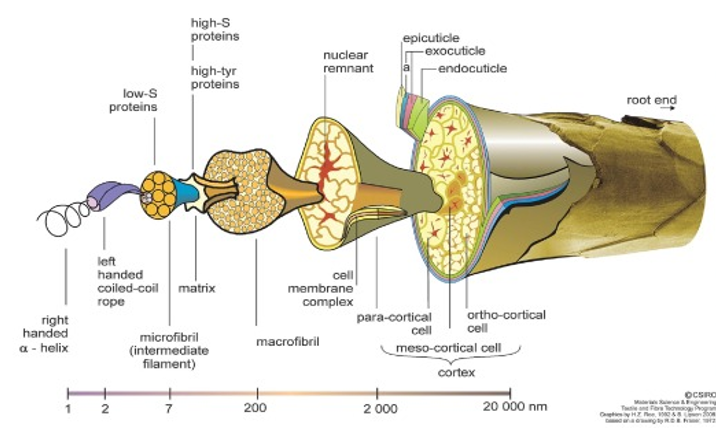
Wool Morphological Structure
3.2 Processing Techniques
Coarse wool used in automotive textiles typically consists of lower-grade fleece, carpet-grade wool. These raw materials are generally underutilised in conventional textile applications due to their larger fibre diameter and coarser handle, but they are highly suitable for technical applications where softness is not the primary requirement. Their availability at relatively low cost, combined with their renewable and biodegradable nature, makes them an economically and environmentally attractive option for automotive use.
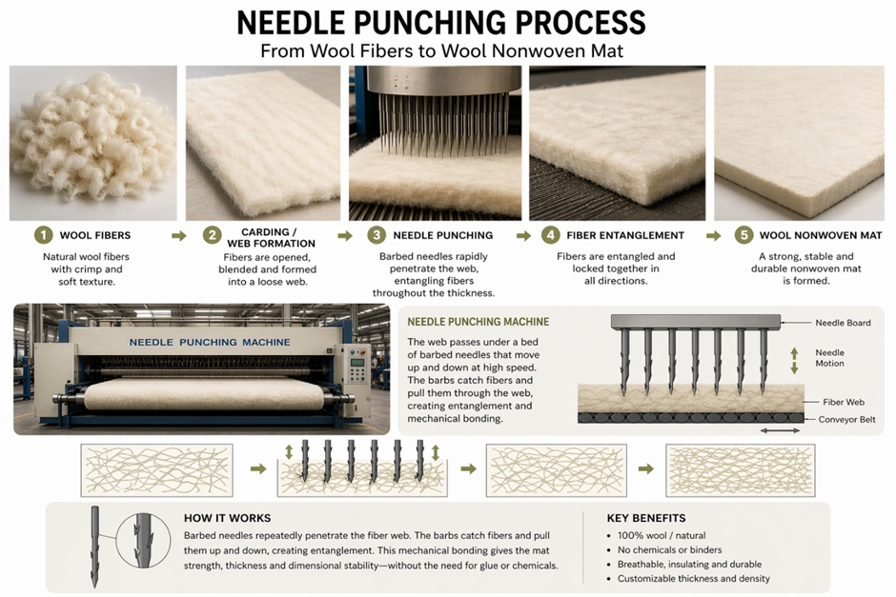
The processing of coarse wool into automotive components is predominantly carried out through nonwoven technologies, which offer high productivity, design flexibility, and cost efficiency.
- Needle punching is one of the most widely used techniques, where fibres are mechanically entangled using barbed needles to form cohesive structures with good strength and porosity.
- Thermal bonding is often employed in blended systems, where thermoplastic fibres such as polyester or polypropylene act as binders, melting upon heating to provide structural integrity.
- Hydroentanglement (spun lace) uses high-pressure water jets to interlock fibres, producing softer and more uniform nonwoven fabrics with enhanced surface properties.
- Felting is another key processing route specific to wool, utilising the natural scaly structure of wool fibres to create dense, interlocked materials without the need for additional binders. Wool felt exhibits excellent thermal insulation, acoustic absorption, and vibration-damping characteristics, making it particularly suitable for applications such as insulation panels, acoustic barriers, and anti-vibration components.
Blending coarse wool with synthetic fibres such as polyester or polypropylene is a common strategy to optimise performance. Polyester improves mechanical strength, dimensional stability, and durability, while polypropylene contributes to lightweight structures and cost reduction. These blends also facilitate thermal bonding processes, enhancing manufacturability. For applications where aesthetics and surface finish are important, such as seat upholstery and interior trims.
Overall, the versatility in processing techniques enables coarse wool to be engineered into a wide range of automotive textile products, from structural nonwovens to decorative interior materials, while maintaining a balance between performance, cost, and sustainability.
4. Applications of Coarser Wool in Automobiles
Coarse wool is increasingly recognised as a versatile material in automotive applications due to its unique combination of mechanical, thermal, and acoustic properties.
4.1 Interior Upholstery
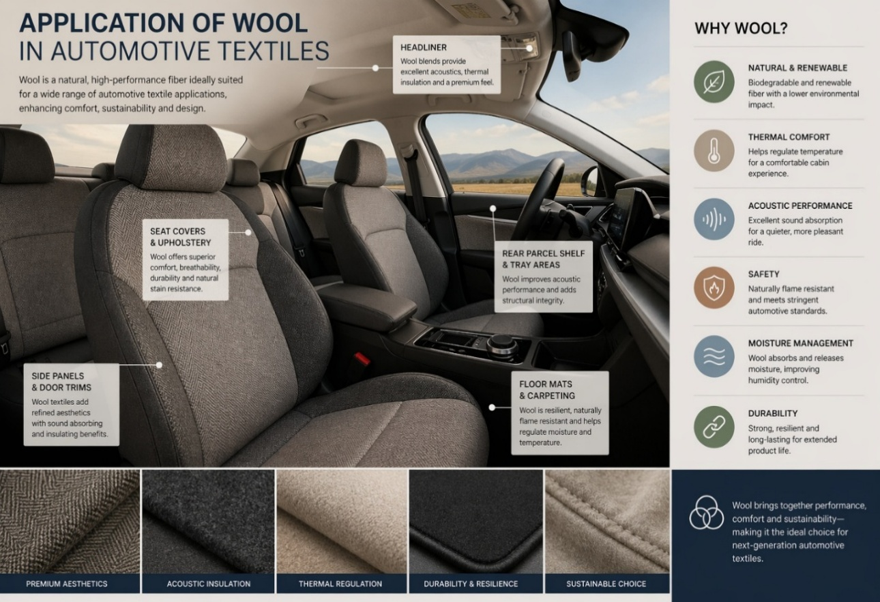
Wool and wool-blended fabrics are used in seat covers, door panels, and headliners, offering durability, comfort, and aesthetic appeal along with moisture regulation.
4.2 Carpets and Floor Coverings
Coarse wool is suitable for carpets due to its high wear resistance, dirt-hiding capability, and thermal insulation properties.
4.3 Acoustic Insulation
Wool felts are used in door panels, dashboards, and roof liners to reduce noise, vibration, and harshness (NVH), enhancing ride comfort.
4.4 Thermal Insulation
Applications include engine compartments, HVAC systems, and cabin barriers, where wool reduces heat transfer and improves energy efficiency.
4.5 Anti-Vibration Components
Wool felt is used in gaskets, seals, and shock-absorbing pads to damp vibrations and minimise noise transmission.
4.6 Filtration Media
Coarse wool fibres are used in air and oil filtration systems due to their ability to capture particles effectively.
5. Advantages Over Synthetic Fibres
Coarse wool offers several advantages over synthetic fibres, including renewability, biodegradability, and lower environmental impact. It provides superior thermal and acoustic insulation, excellent moisture management, and inherent flame resistance without requiring chemical treatments. These multifunctional properties reduce processing requirements and improve overall efficiency.
6. Sustainability Benefits
Wool is a renewable resource obtained annually and is fully biodegradable at the end of its lifecycle. Its use promotes the utilisation of low-value fibres and supports circular economy principles. Wool-based automotive components contribute to reduced carbon footprint, improved recyclability, and lower life cycle impact.
7. Conclusion
Coarser wool, once considered a low-value byproduct, is emerging as a high-performance material in automotive textiles. Its unique combination of thermal insulation, acoustic damping, flame resistance, and sustainability makes it a viable alternative to conventional synthetic fibres. With increasing emphasis on eco-friendly materials and lightweight design, coarse wool holds significant potential for future automotive applications.
8. Reference
[1] A.R. Bunsell, Handbook of Technical Textiles, Woodhead Publishing, 2018.https://doi.org/10.1016/B978-0-08-101272-7.00001-1
[2] A.R. Horrocks, S.C. Anand, Handbook of Technical Textiles, Woodhead Publishing, 2000
https://doi.org/10.1533/9781855739970
[3] W.S. Simpson, G.H. Crawshaw, Wool: Science and Technology, Woodhead Publishing, 2002. https://doi.org/10.1533/9781855735972
[4] J.W.S. Hearle, High-Performance Fibres, Woodhead Publishing, 2001.https://doi.org/10.1533/9781855737570
[5] B.P. Saville, Physical Testing of Textiles, Woodhead Publishing, 1999.https://doi.org/10.1533/9781855733671
[6] W.E. Morton, J.W.S. Hearle, Physical Properties of Textile Fibres, 2008. https://doi.org/10.1533/9781845694425
[7] D.V. Parikh, Y. Chen, Thermal insulation properties of fibres, Textile Research Journal, 2005.https://doi.org/10.1177/0040517505055575
[8] K.O. Ballagh, Acoustical properties of wool, Applied Acoustics, 1996. https://doi.org/10.1016/0003-682X(95)00043-7
[9] J. Alongi et al., Thermal degradation and flame retardancy of wool, Polymer Degradation and Stability, 2015. https://doi.org/10.1016/j.polymdegradstab.2015.01.020
[10] A.R. Horrocks, Flame retardant textiles, Woodhead Publishing, 2013.https://doi.org/10.1533/9780857098924
[11] S.J. Russell, Handbook of Nonwovens, Woodhead Publishing, 2007.https://doi.org/10.1533/9781845691998
[12] K.L. Pickering, Natural Fibre Composites, 2016.https://doi.org/10.1533/9781782421276
[13] A. Aluigi et al., Wool-based filtration materials, Journal of Hazardous Materials, 2007.https://doi.org/10.1016/j.jhazmat.2007.04.046
[14] L. Shen et al., Environmental impact of fibres, Resources, Conservation and Recycling, 2010.https://doi.org/10.1016/j.resconrec.2010.01.002
[15] S.S. Muthu, Environmental impact of textiles, 2014.https://doi.org/10.1016/B978-1-78242-195-5.00001-9