
| Dr Dinesh Bhatia Assistant Professor, Textile Engineering, Jawahar Lal Nehru Government Engineering College, Sundernagar | Dr Ankush Sharma Assistant Professor, Textile Engineering, Jawahar Lal Nehru Government Engineering College, Sundernagar |
Summary
The automobile sector is undergoing a substantial shift towards sustainable transportation as a result of stringent pollution restrictions, growing environmental issues, and increased demand for lightweight vehicles. Natural fiber composites (NFCs) have come to prominence as attractive substitutes to traditional composites made from synthetic fibers, mainly due to their renewable nature, superior specific mechanical performance, low density, and biodegradability. Fibers like hemp, sisal, roselle, jute, kenaf, banana, flax, and bamboo are currently being used in vehicle parts like seat backs, dashboards, roof liners, door panels, and interior trims. This article provides a detailed overview of natural fiber composites used in environmentally friendly transportation vehicles, including their features, production methods, benefits, problems, and usage in industry.
Introduction
Recently, automobile manufacturing, due to the demand for lightweight and environmentally friendly components, has encouraged the growth of natural fiber-reinforced composites (NFRCs). These concerns also led to environment-related issues and harsh CO₂ pollution rules. The necessity for fuel-efficient automobiles has motivated engineers and automotive makers to replace traditional synthetic components with sustainable options such as natural fiber-reinforced composites. These composites are produced by the reinforcement of natural fibers with polymer matrices like polyester, epoxy, or polypropylene. From the abovementioned polymer matrices, epoxy resin is frequently utilized because of its high mechanical strength, adhesive qualities, dimensional stability, and moisture resistance. The addition of natural fibers into polymer matrices not only decreases vehicle weight but also lessens environmental effect and enhances recyclability over the product’s life cycle. In the last twenty years, automotive companies have progressively employed NFRCs in semi-assembled parts and the interior of the vehicle, including dashboards, trim elements, seat backs, package trays, roof liners, and door panels. In spite of their benefits, NFRCs experience problems like inadequate interfacial bonding with polymers that are hydrophobic polymers, moisture absorption, and inferior fire resistance. To address these limitations, hybridization approaches and diverse surface treatments are being investigated to enhance fiber–matrix adhesion and overall composite efficacy. Figure 1a illustrates the characteristics of NFRCs and their uses. Figure 1b illustrates the multiple stages involved in the manufacture of NFRCs. This article discusses the characteristics and applications of natural fibers used in composites, various manufacturing techniques of NFRCs, the disadvantages of NFRCs, and various treatments conducted to enhance their performance.
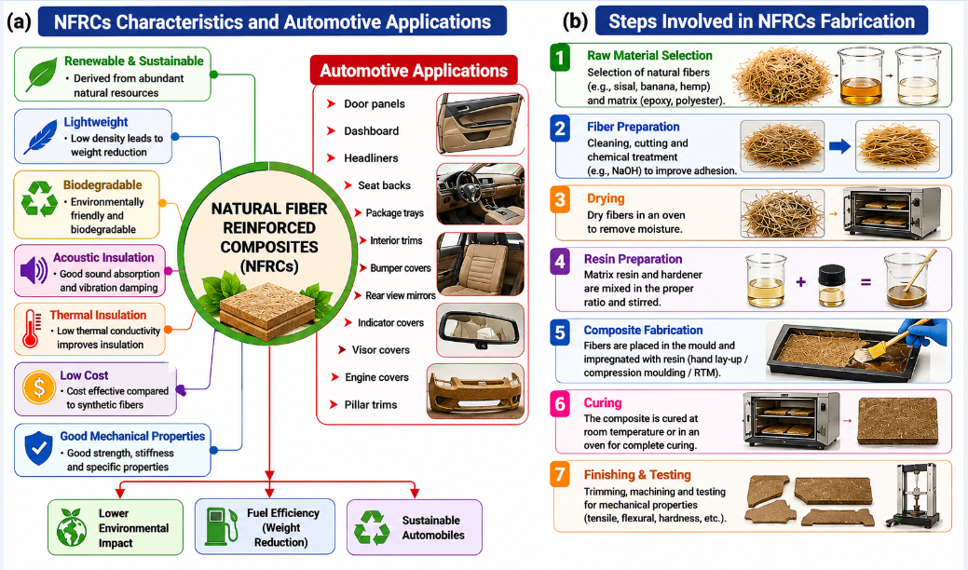
Figure 1: Steps involved in the fabrication, characteristics, and applications of NFRCs
Characteristics and Application of Natural Fibers used in Composites
Natural fibers are derived from animals, plants, and minerals. Commonly, plant-based cellulosic fibers are predominantly recommended for automotive sectors owing to their affordability, non-toxic attributes, lightweight properties, and biodegradability. Plant-based cellulosic fibers are derived from various plant components, such as leaves, stems, fruits, and roots. Various factors, including cellulose concentration, environmental growing circumstances, and microfibrillar angle, influence the characteristics of these fibers. The composites formulated from this natural fiber are called natural fiber-reinforced composites (NFRCs). NFRCs have advantages over composites formulated from synthetic fibers, including low density, commendable mechanical performance, diminished environmental effect, and recyclability. Hemp, flax, and kenaf are regarded as highly promising natural fibers due to their exceptional strength-to-weight ratio and potential to substitute conventional synthetic materials in sustainable automotive manufacture. Table 1 represents the properties of various natural fibers and their applications in automobile components.
Table 1: Properties of Various Natural Fibers and Its Application in Automobile Components
| Type of Fiber | Tensile Strength (MPa) | Density (g/cm³) | Elastic Modulus (GPa) | Elongation (%) | Automobile Applications |
| Kenaf | 295–930 | 1.20 | 14–53 | 1.6 | Package trays, insulation panels |
| Sisal | 400–700 | 1.45 | 9–22 | 2–3 | Seat backs, interior panels |
| Flax | 500–1500 | 1.40 | 60–80 | 1.2–1.6 | Structural panels, parcel shelves |
| Hemp | 550–900 | 1.48 | 70 | 1.6 | Door panels, dashboards, seat backs |
| Jute | 400–800 | 1.30 | 20–55 | 1.5–1.8 | Interior trims, roof liners |
| Coir | 95–230 | 1.15 | 4–6 | 15–25 | Acoustic insulation, floor mats |
| Bamboo | 140–800 | 0.90 | 11–46 | 1.5–3.5 | Reinforcement structures, dashboards |
| Banana | 529–914 | 1.35 | 27–32 | 1.7–3.0 | Door trims, lightweight panels |
Manufacturing Techniques of Natural Fiber Reinforced Composites (NFRCs)
Natural fiber-reinforced composites (NFRCs) can be produced from any of the above-mentioned techniques, such as compression moulding, injection moulding, resin transfer moulding, and hand lay-up technique, based on the required characteristics like production scale and application specifications in automobiles. Figure 2 shows various manufacturing techniques for NFRCs. Compression moulding is a prevalent technology used to produce various NFRCs suitable for the automobile sector. In this technique, natural fibers and resin are poured into a heated mould and subjected to pressure to fabricate lightweight and dimensionally stable components.
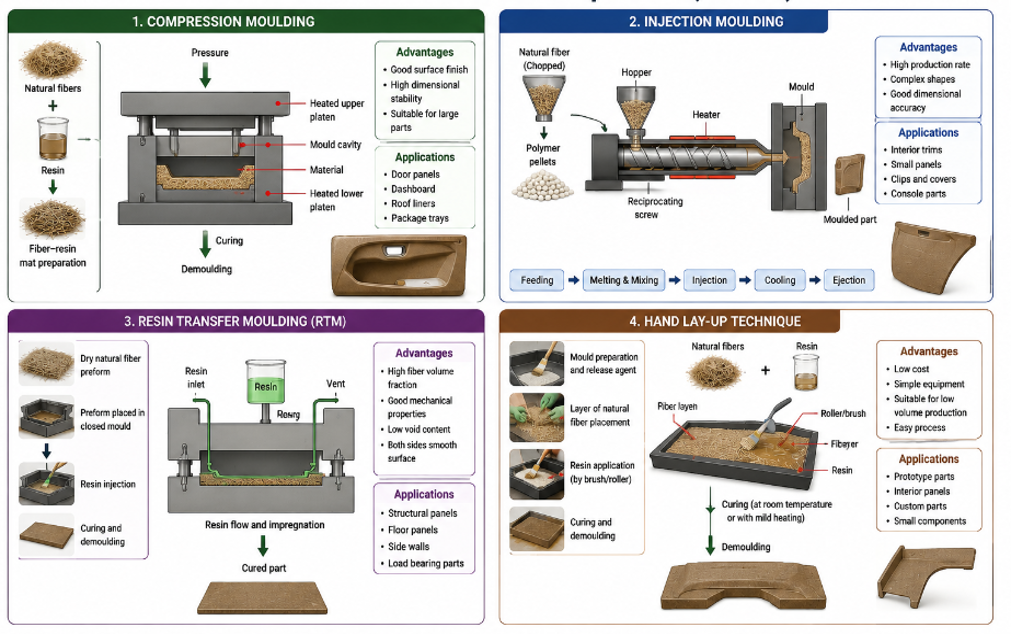
Figure 2: Various fabrication techniques for NFRCs
The NFRCs developed through compression moulding are suitable for door panels and dashboards used in vehicles. Injection moulding is frequently employed for thermoplastic composites. This technique helps in mass manufacturing due to its capability for intricate shape development, superior surface polish, and rapid production rate. In this method, short natural fibers combined with a polymer matrix are injected into a mould cavity under high pressure. Resin Transfer Moulding (RTM) is a sophisticated closed-moulding technique wherein dry natural fibers are positioned within a mould, and liquid resin is injected to permeate the fibers thoroughly. The resulting composites from this technique have enhanced mechanical properties and less void content. The hand lay-up approach is among the most straightforward and cost-effective methods employed for low-volume production and prototype development. During this procedure, natural fibers are systematically layered, and resin is applied using brushes or rollers prior to curing. The fabrication procedures profoundly affect the mechanical, thermal, and physical properties of NFRCs and are widely utilized in sustainable automotive applications because they yield lightweight, environmentally friendly, and high-performance composite materials.
Disadvantages of NFRC’s
Despite lightweight benefits and environmentally friendly nature, NFRCs have a few drawbacks, which prevent their widespread use in high-performance vehicle components. Figure 3 illustrates various disadvantages of natural fiber-reinforced composites.
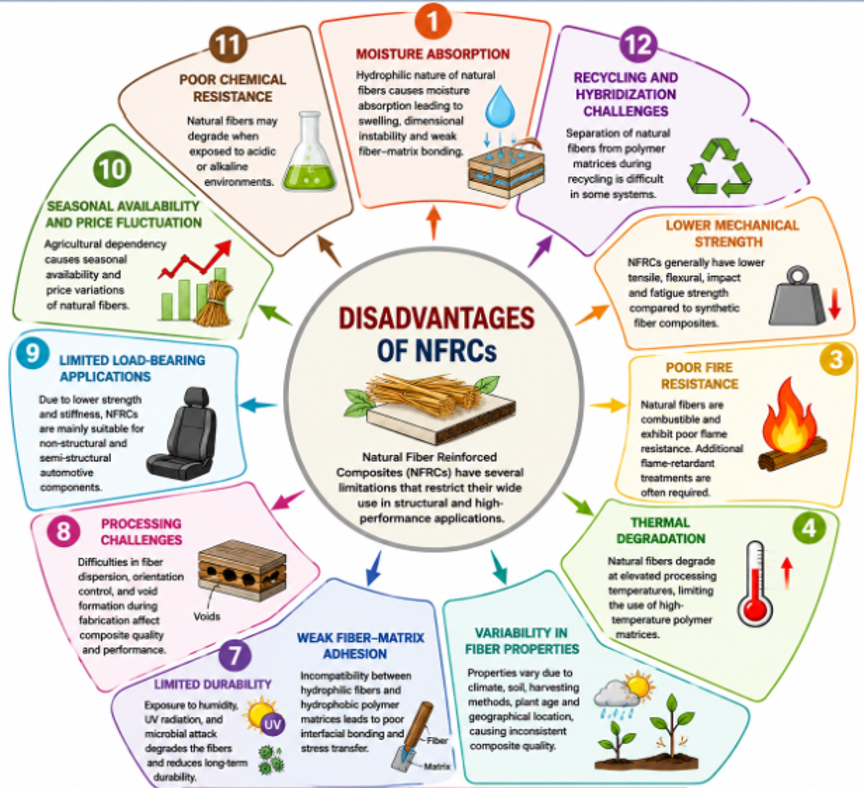
Figure 3: Disadvantages of NFRC’s
One of the primary disadvantages is that they have lesser mechanical and impact strength than synthetic fiber composites, such as glass fiber composites. NFRCs also absorb a lot of moisture because of the hydrophilic nature of natural fibers, which causes dimensional instability, swelling, and deterioration of fiber-matrix interfacial bonding. Various researchers in their study concluded that these composites face fiber debonding and void formation problems due to penetration of moisture, ultimately damaging the composite structure, lowering mechanical performance, and durability. Furthermore, composites prepared from same natural fibers still face variable composite properties due to variation in natural fiber properties. These variations in natural fibers came from harvesting methods, plant age, and geographical location. Lower fire resistance and thermal stability of NFRC’s limit their use in high-temperature automotive applications.
Treatment of Natural Fibers
Table 2 explains the various physical, chemical, and nano treatments that enhance the performance of natural fibers during the fabrication of NFRCs.
Table 2: Physio-Chemical Treatment for Natural Fibers
| Treatment Type | Treatment Method | Chemicals/Technique Used | Improvements in Properties | Mechanism of Action | Automobile Applications |
| Physical Treatment | Corona Treatment | High-voltage corona discharge | Improved surface energy and interfacial bonding | Activates the fiber surface and improves wettability | Headliners, side panels, insulation components |
| Plasma Treatment | Argon plasma, oxygen plasma | Enhanced hydrophobicity, adhesion, flexural strength and tensile | Modifies fiber surface roughness and surface energy | Door panels, dashboards, parcel shelves | |
| Duralin Treatment | Heat treatment process | Reduced swelling and enhanced dimensional stability | Reduces residual stresses and moisture affinity | Underbody panels, thermal insulation panels | |
| Chemical Treatment | Acetylation | Acetic anhydride | Improved moisture resistance and dimensional stability | Introduces hydrophobic acetyl groups | Door trims, roof liners |
| Peroxide Treatment | Benzoyl peroxide | Lower moisture uptake and improved mechanical strength | Improves crosslinking and grafting | Vehicle panels and casings | |
| Silane Treatment | Silane coupling agents | Improved mechanical properties and interfacial bonding | Forms chemical bridge between fiber and matrix | Structural automotive composites | |
| Ozone Treatment | Ozone gas | Enhanced contact angle surface and energy | Oxidizes and activates surface | Adhesive-bonded composites | |
| Isocyanate Treatment | Toluene diisocyanate | Reduced water absorption and Improved strength | Forms urethane linkages with hydroxyl groups | Structural reinforcements | |
| Benzoylation | Benzoyl chloride | Enhanced hydrophobicity and thermal stability | Reduces hydrophilicity by replacing hydroxyl groups | Heat-resistant components | |
| Enzyme Treatment | Hydrolases, oxidoreductases | Better bonding and eco-friendly surface cleaning | Selective removal of non-cellulosic materials | Sustainable interior products | |
| Grafting Treatment | Acrylonitrile, methyl methacrylate | Enhanced durability and UV resistance | Grafts polymer chains on fiber surface | Exterior automobile panels | |
| Alkali Treatment (Mercerization) | NaOH, KOH | Improved flexural strength, tensile, and thermal stability | Removes lignin, hemicellulose, waxes and oils | Body panels, dashboards, trunk liners | |
| Sodium Chlorite Treatment | Sodium chlorite | Enhanced modulus and tensile strength | Removes lignin and exposes cellulose | Automotive reinforcement composites | |
| Hybrid Treatment | Combined Alkali + Silane | Multi-step chemical treatment | Superior durability and adhesion | Synergistic impurity removal and coupling | Semi-structural automotive components |
| Nano/Advanced Treatment | Graphene Coating | Graphene oxide | Enhanced tensile, shear and thermal properties | Deposits graphene on fiber surface | High-performance lightweight composites |
Conclusions
Natural fiber-reinforced composites (NFRCs) have emerged as sustainable and lightweight alternatives for automotive applications due to their biodegradability, low density, and favourable mechanical properties. Although challenges such as moisture absorption, lower thermal stability, and variable fiber properties still exist, advanced surface treatments and fabrication techniques can significantly enhance their overall performance and durability.